
Introduction
Mathematics becomes easier when students have access to clear explanations, useful examples, and reliable learning resources. However, many learners struggle with complicated equations, algebraic expressions, geometry problems, and lengthy calculations. A maths solver AI can help simplify these challenges by providing step-by-step solutions and explanations that make mathematical concepts easier to understand.
Unlike a basic calculator that primarily returns numerical answers, an AI-powered math solver can help users explore different stages of a problem. Depending on the tool, it may explain formulas, simplify expressions, solve equations, and identify alternative methods for reaching a result. These features can support students, teachers, professionals, and anyone who wants to strengthen their mathematical abilities.
The real value of maths solver AI lies in how people use it. Instead of copying answers without understanding them, learners can use the technology to review their work, identify mistakes, and practise unfamiliar concepts. When combined with regular study and independent problem-solving, it can become a practical learning companion.
What Is Maths Solver AI?
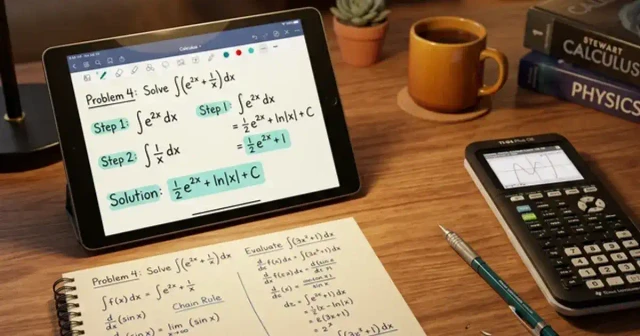
Maths solver AI refers to artificial intelligence technology designed to help users solve mathematical problems and understand the reasoning behind solutions. These tools may use mathematical algorithms, symbolic computation, language processing, and image recognition to interpret questions and generate relevant answers.
Users can often enter a problem by typing an equation, pasting mathematical expressions, or uploading a photograph of a worksheet. Some tools also allow questions to be written in ordinary language, making them accessible to people who are unfamiliar with advanced mathematical notation.
For example, a user might enter the equation 2x + 6 = 18. A suitable solver can explain that subtracting six from both sides gives 2x = 12. Dividing both sides by two produces x = 6.
This example demonstrates how a solver can present both the answer and the reasoning. Nevertheless, capabilities vary between platforms, so users should check whether a particular tool supports their mathematical topic and preferred input method.
How Does an AI Math Solver Work?
An AI math solver generally follows several stages to process a question and produce a solution. The exact process depends on the technology used by the platform.
First, the tool receives the problem through typed text, an uploaded image, or another supported input method. If the question appears in a photograph, image recognition may identify numbers, symbols, fractions, and mathematical operators.
Next, the system interprets the mathematical expression. Depending on its design, it may use a symbolic mathematics engine, numerical algorithms, an AI model, or a combination of these technologies.
The solver then applies appropriate mathematical rules to generate a result. For supported questions, it may display intermediate calculations, explain relevant formulas, or provide alternative approaches.
Finally, the user reviews the answer and checks whether the reasoning matches the original question.
AI-generated explanations are not always correct. Complex notation, unclear photographs, ambiguous wording, and unsupported problem types can produce errors. Reviewing calculations and verifying important results remain essential parts of the process.
Key Features of Maths Solver AI
Different platforms provide different features, but several capabilities are especially useful for everyday learning.
- Step-by-step solutions: Breaks complicated problems into smaller calculations that are easier to follow.
- Equation solving: Helps solve supported linear, quadratic, and other algebraic equations.
- Expression simplification: Reduces mathematical expressions into more manageable forms.
- Formula explanations: Describes how mathematical rules apply to a particular question.
- Image-based problem solving: Allows users to submit photographs when the tool supports image input.
- Graphing assistance: Some platforms display graphs of functions and equations.
- Answer verification: Helps users compare their own solutions with an independently generated result.
- Practice support: Can generate additional examples or explain similar questions for revision.
These features can save time during study sessions. However, a tool should be selected according to the user’s requirements rather than the number of features it advertises.
Mathematical Topics You Can Explore
A maths solver AI can support multiple areas of mathematics, although the available coverage differs between tools.
Arithmetic: Basic operations, percentages, ratios, decimals, fractions, and order of operations are common starting points.
Algebra: Learners can explore variables, equations, inequalities, polynomials, and factorisation. Step-by-step explanations are particularly useful when several transformations are required.
Geometry: Some tools help calculate areas, perimeters, angles, and volumes. More advanced platforms may assist with coordinate geometry and related formulas.
Trigonometry: Supported solvers can explain sine, cosine, tangent, identities, and angle calculations.
Calculus: Certain systems handle limits, derivatives, integrals, and related mathematical expressions.
Statistics and probability: Some tools explain averages, distributions, probability calculations, and statistical formulas.
Before entering a question, check whether the selected platform supports the relevant topic. A tool designed for basic arithmetic may not provide dependable explanations for advanced calculus or proof-based mathematics.
Benefits for Students and Independent Learners
One major advantage of maths solver AI is its ability to provide assistance when a teacher or tutor is unavailable. Students can revisit difficult questions, examine worked examples, and explore concepts at their own pace.
Another benefit is immediate feedback. When learners compare their attempts with a worked solution, they may discover whether an error occurred during substitution, simplification, calculation, or formula selection.
AI tools can also make revision more organised. Students can group questions by topic, practise weak areas, and request explanations using simpler language when available.
For independent learners, these systems can reduce the frustration associated with unfamiliar problems. Instead of abandoning a question, users can investigate the first step and attempt the remaining calculations themselves.
Teachers may also use AI solvers to prepare examples, check calculations, and develop practice questions. However, educational materials should always be reviewed before being shared with students.
Maths Solver AI Compared With Traditional Calculators
Traditional calculators remain valuable for numerical accuracy and efficient calculations. AI-powered solvers provide a different kind of assistance by potentially explaining the process behind an answer.
| Feature | Traditional Calculator | Maths Solver AI |
|---|---|---|
| Basic arithmetic | Excellent for supported operations | Usually supported |
| Step-by-step explanations | Limited on basic models | Available on some platforms |
| Complex equations | Depends on calculator type | Depends on mathematical capabilities |
| Natural-language questions | Generally unavailable | Supported by some tools |
| Photograph input | Uncommon | Available on selected platforms |
| Concept explanations | Usually limited | May provide detailed explanations |
| Independent verification | Useful for numerical checks | Can compare methods, but may make mistakes |
Neither option replaces the other in every situation. A calculator is often the simplest choice for routine arithmetic, while an AI solver can be more useful when a learner needs an explanation or guidance through a multi-step problem.
How to Use Maths Solver AI Effectively
Getting useful results requires more than entering a question and accepting the first answer. A thoughtful approach improves both accuracy and learning.
Step 1: Enter the complete problem. Include every number, operator, condition, and relevant unit. Missing information can change the answer.
Step 2: Check the input. If you upload an image, make sure it is clear, correctly oriented, and free from cropped equations.
Step 3: Request an explanation. When possible, ask the tool to show intermediate steps and explain the mathematical rule used at each stage.
Step 4: Attempt the problem independently. Try solving it before reading the complete solution. If you become stuck, examine one step and continue working.
Step 5: Verify the result. Substitute the answer into the original equation or use another suitable method to check the calculation.
Step 6: Practise a similar question. Applying the same concept to a different problem helps determine whether you have understood the method.
Following these steps turns an answer-generating tool into a more effective study resource.
Choosing the Right AI Math Solver
Selecting an appropriate platform depends on your educational level, mathematical goals, and preferred way of working.
Look for a tool that explains its calculations clearly rather than simply presenting a final answer. If you regularly work with handwritten equations, image recognition may be important. If you study functions or calculus, check whether the platform supports symbolic calculations, graphing, and advanced mathematical notation.
Ease of use also matters. A straightforward interface makes it easier to enter expressions, review explanations, and move between questions without unnecessary distractions.
Consider these factors before choosing a platform:
- Supported mathematical topics and difficulty levels.
- Quality and clarity of worked solutions.
- Availability of image uploads and graphing features.
- Free usage limits, subscriptions, and other costs.
- Privacy policies and the handling of uploaded information.
- Compatibility with your device and browser.
Avoid assuming that every tool described as an AI math solver offers identical functionality. Testing a few representative questions can help you determine whether a platform meets your needs.
Common Mistakes to Avoid
Although maths solver AI can be helpful, careless use may limit its educational value.
The first mistake is copying answers without understanding the method. This may finish an assignment quickly but leaves the learner unprepared for unfamiliar questions.
Another mistake is trusting every explanation. AI systems can misunderstand mathematical symbols, apply inappropriate methods, or produce convincing but incorrect reasoning. Important answers should be checked independently.
Poorly formatted inputs can also create problems. For example, an unclear fraction or missing bracket may change the meaning of an expression. Reviewing the entered question before submitting it helps prevent avoidable errors.
Students should also follow their school or university rules regarding AI assistance. Some assignments permit learning support but prohibit submitting AI-generated work as independent work.
Finally, avoid sharing sensitive personal information when using online tools. Mathematical questions rarely require passwords, financial details, or private identification information.
Frequently Asked Questions
What Is Maths Solver AI Used For?
Maths solver AI helps users work through mathematical questions, understand formulas, simplify expressions, and check calculations. Depending on the platform, it can support arithmetic, algebra, geometry, calculus, and other topics.
Can Maths Solver AI Show Step-by-Step Solutions?
Yes, many AI-powered math tools offer step-by-step explanations for supported questions. However, the level of detail varies. Users should select a platform that explains the reasoning rather than displaying only the final result.
Is Maths Solver AI Free to Use?
Some tools provide free access to basic features, while others charge for advanced explanations, image recognition, higher usage limits, or premium capabilities. Check the current pricing and restrictions before choosing a service.
Can Maths Solver AI Solve Difficult Equations?
Certain platforms can solve advanced equations and mathematical expressions. Their capabilities depend on the subject, complexity, notation, and underlying technology. Always verify solutions involving advanced mathematics.
Is Maths Solver AI Suitable for Students?
Yes, it can support students by explaining unfamiliar concepts, reviewing homework, and providing additional practice. Students should use it to develop understanding and follow their institution’s academic integrity requirements.
Are AI Math Solver Answers Always Correct?
No. AI solvers can misinterpret inputs or generate incorrect calculations and explanations. Check the original question, review each step, and verify the result using mathematical rules or another reliable method.
Conclusion
Maths solver AI offers a practical way to approach mathematical challenges with greater clarity and confidence. From basic arithmetic to selected advanced topics, these tools can explain calculations, simplify equations, and help learners review their work. Their usefulness depends on the features available, the accuracy of the input, and the quality of the explanations provided.
The best results come from combining AI assistance with independent thinking. Students should attempt problems themselves, study the reasoning behind each solution, and verify answers before relying on them. Teachers and other learners can also benefit by using these tools to prepare examples and explore alternative methods.
Ultimately, maths solver AI should support mathematical understanding rather than replace it. When used responsibly, it can make practice more accessible, help identify mistakes, and encourage learners to develop stronger problem-solving skills.