
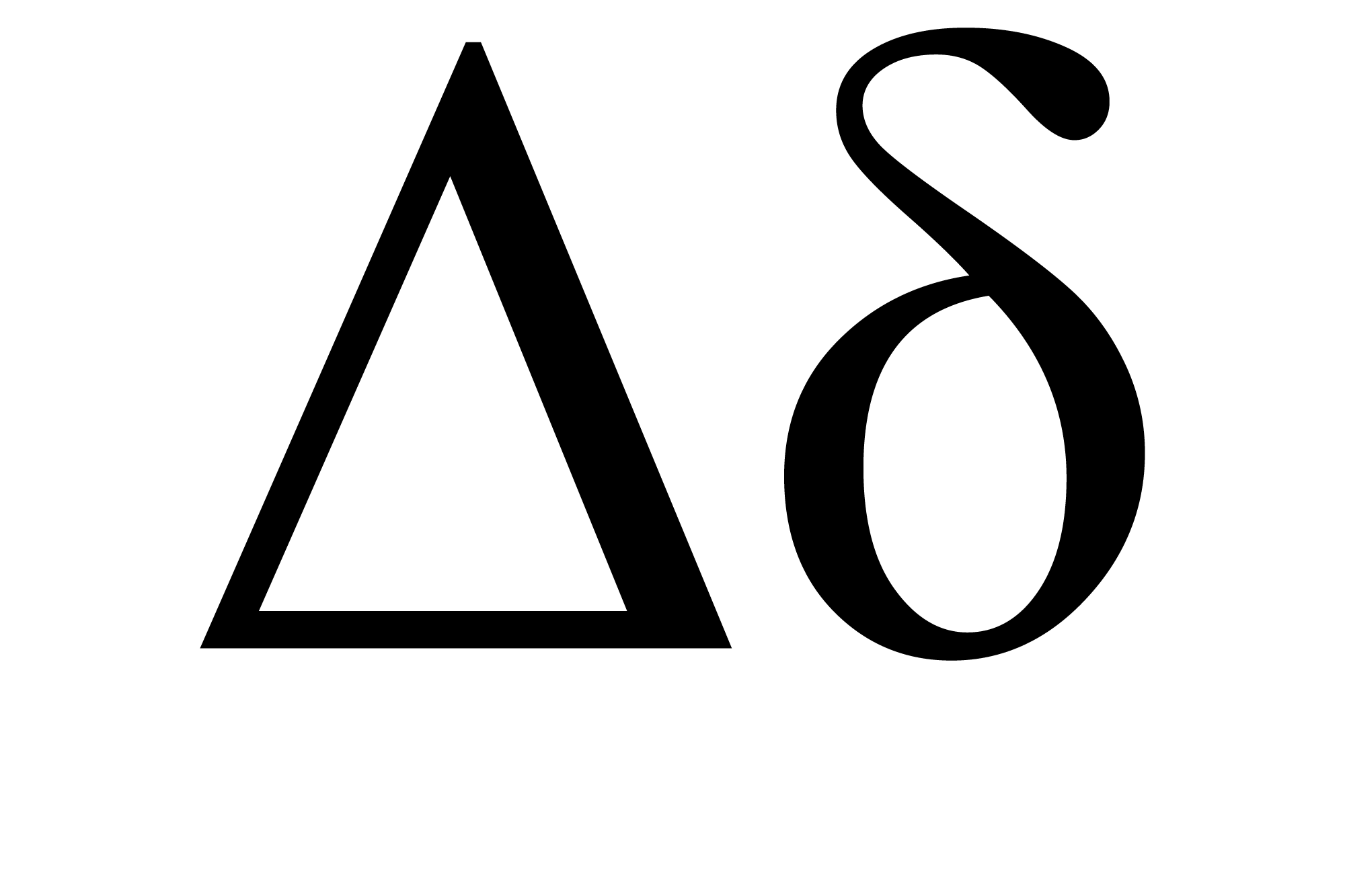
The Greek letter delta has a special place in mathematics because it often represents change, difference, or variation between two values. Written as Δ when uppercase and δ when lowercase, the symbol appears across algebra, geometry, calculus, statistics, and other mathematical fields. Understanding the delta symbol meaning makes it easier to read equations, interpret formulas, and understand how one quantity changes in relation to another.
In everyday mathematical problems, delta is frequently connected with the idea of comparing a starting value with a final value. For example, if a quantity changes from 20 to 35, the difference is 15. This change can be represented as Δx when the variable involved is x. The same concept becomes even more important in calculus, where symbols such as Δx describe finite changes while related concepts lead toward derivatives and rates of change.
The meaning of delta is not restricted to one mathematical topic. Its interpretation depends on the context in which it appears. In one equation, Δ may describe a difference between two measurements; in another, it may refer to a discriminant used to determine the nature of quadratic equation roots. Lowercase δ can have additional meanings in advanced mathematics and science. Because of this flexibility, learning how delta works in different situations is more useful than memorizing a single definition.
What Does Delta Mean in Mathematics?
The simplest delta symbol meaning is “change” or “difference.” When mathematicians want to show how much a quantity has changed, they can place an uppercase delta before the variable. For instance, Δx means the change in x. If x initially has a value of 8 and later becomes 13, the change can be calculated as 13 − 8 = 5. Therefore, Δx is 5.
This concept can be expressed using a general relationship: Δx = final value − initial value. The same approach works with many variables. Δy represents a change in y, Δt represents a change in time, and ΔP can represent a change in pressure when working with a suitable scientific or mathematical problem. The symbol itself does not necessarily tell you what the variable represents; rather, the surrounding equation provides that information.
Delta can also describe a difference that is not necessarily positive. Suppose a temperature decreases from 30°C to 22°C. The change is 22 − 30 = −8°C. In this situation, ΔT is −8°C, showing that the quantity decreased. This is important because delta does not simply mean an increase. It describes the net change between two states, and the sign indicates the direction of that change.
Uppercase Delta and Lowercase Delta
A major point of confusion for beginners is the difference between uppercase Δ and lowercase δ. Both are Greek letters, but their mathematical uses can differ considerably. Uppercase delta is commonly associated with a finite change or difference, while lowercase delta can represent a small quantity, a variation, a special mathematical object, or another context-specific concept.
The delta symbol meaning therefore depends partly on capitalization. In elementary algebra and calculus, Δ is often used to represent a measurable change between two values. Lowercase δ may appear in more advanced mathematical writing, including topics involving small variations, geometry, probability, or specialized definitions. There is no universal rule that assigns exactly one meaning to lowercase delta in every branch of mathematics.
| Symbol | Common interpretation | Example |
|---|---|---|
| Δ | Finite change or difference | Δx = x₂ − x₁ |
| δ | Small variation or context-specific quantity | δx in advanced mathematics |
| Δx | Change in x | 15 − 10 = 5 |
| Δy | Change in y | 24 − 18 = 6 |
| Δt | Change in time | 12 s − 5 s = 7 s |
Students should pay attention to the definition given in a particular lesson, textbook, or equation. A symbol can have a specialized meaning in one subject and a different meaning elsewhere. Context is therefore essential when interpreting mathematical notation.
Delta in Algebra
In algebra, delta commonly appears when comparing two values or studying changes in variables. Consider a variable x that starts at 12 and changes to 19. The change can be written as Δx = 19 − 12 = 7. This notation gives a concise way to describe the difference without repeatedly writing “final value minus initial value.”
Delta also has a particularly important role in quadratic equations. For a quadratic equation written as ax² + bx + c = 0, the expression b² − 4ac is called the discriminant. It is frequently represented by the uppercase Greek letter Δ:
Δ = b² − 4ac
The value of this discriminant helps determine the number and type of real solutions. If Δ is positive, the quadratic equation has two distinct real roots. If Δ equals zero, it has one repeated real root. If Δ is negative, it has no real roots, although it has two complex roots.
This application demonstrates why the delta symbol meaning cannot always be reduced to the word “change.” In the quadratic formula, Δ represents a specific calculated expression rather than a simple difference between an initial and final measurement. Recognizing the context prevents students from applying the wrong interpretation.
Delta in Calculus
Calculus gives delta an even more important role because the subject frequently studies change. Symbols such as Δx and Δy are used when discussing finite changes in variables. If x changes from x₁ to x₂, then Δx can be written as x₂ − x₁. Similarly, Δy represents the corresponding change in y.
For example, suppose a function produces y = 10 when x = 2 and y = 22 when x = 5. The change in x is 5 − 2 = 3, while the change in y is 22 − 10 = 12. The average rate of change is therefore Δy/Δx = 12/3 = 4. This calculation provides an intuitive introduction to the idea of slope and rate of change.
Calculus then takes the concept further. Instead of considering only a finite change, calculus can examine what happens as the change in x becomes extremely small. This leads to the idea of a limit and eventually to derivatives. In this way, delta notation provides a bridge between basic comparisons and more advanced concepts involving instantaneous change.
Understanding Δx and Δy
The expressions Δx and Δy are especially useful for understanding graphs. If a point moves from one location to another, Δx measures the horizontal change while Δy measures the vertical change. The relationship between these two quantities is central to finding slope.
For a straight-line graph, the slope can be expressed as:
Slope = Δy / Δx
Suppose a line moves from the point (2, 4) to (6, 12). The horizontal change is Δx = 6 − 2 = 4, while the vertical change is Δy = 12 − 4 = 8. Therefore, the slope is 8/4 = 2. This provides a practical example of how delta notation makes mathematical relationships easier to understand.
Delta in Geometry
Geometry uses the Greek letter delta in several ways, although its exact meaning depends on the problem. One familiar use involves triangular shapes and area calculations. In some mathematical contexts, a capital delta may be associated with a triangle or a triangular region. The Greek letter itself is historically connected with a triangular shape, which helps explain why it appears in certain geometric notation.
Delta can also appear when describing changes in geometric measurements. If the length of a side changes, ΔL may represent the difference between the original and new lengths. Likewise, ΔA could indicate a change in area. These applications are particularly useful when geometry is combined with algebra, physics, engineering, or optimization.
The delta symbol meaning in geometry should therefore be interpreted alongside the notation surrounding it. If delta is attached to a variable, it may indicate a change in that measurement. If it is being used as part of a named geometric notation, its interpretation may be more specialized.
Delta in Statistics and Data Analysis
Changes and differences are fundamental to statistics, making delta notation useful in data analysis as well. When researchers compare measurements before and after an event, delta can describe the amount of change. For example, if an average score increases from 68 to 75, the change is ΔScore = 75 − 68 = 7 points.
This kind of calculation is useful when evaluating trends, comparing groups, or measuring the effect of an intervention. A positive delta indicates an increase, while a negative delta indicates a decrease. A zero delta means that the measured quantity remained unchanged between the two observations.
In more advanced statistical and mathematical work, lowercase delta may appear in specialized notation. Its exact interpretation can depend on the model, distribution, parameter, or method being used. Students working with statistics should therefore avoid assuming that every delta symbol has the same definition.
Common Uses of the Delta Symbol
The delta symbol meaning becomes easier to remember when its most common applications are viewed together. In basic mathematics, delta often signals a difference between two values. In calculus, it is strongly associated with finite changes in variables. In algebra, uppercase delta can represent the discriminant of a quadratic equation. In geometry and science, it may indicate a change in a measurable quantity or have a specialized notation-based meaning.
Some common interpretations include:
- Δx: change in the value of x.
- Δy: change in the value of y.
- Δt: change in time.
- Δ = b² − 4ac: discriminant of a quadratic equation.
These examples show that delta is not a variable with one fixed numerical value. Instead, it is a notation tool whose meaning comes from the mathematical relationship in which it appears.
Why Is Delta Important for Students?
Learning delta notation is valuable because it teaches students to think about relationships rather than isolated numbers. Instead of simply identifying a beginning and ending value, students can describe the difference between them using a compact mathematical expression. This way of thinking becomes increasingly important in algebra, calculus, physics, economics, statistics, and engineering.
The symbol also prepares learners for more advanced mathematical concepts. Understanding Δx as a finite change makes it easier to understand average rates of change. From there, students can begin exploring limits, derivatives, and instantaneous rates. The progression demonstrates how basic mathematical notation can serve as a foundation for sophisticated ideas.
Another benefit is improved mathematical reading. Equations can contain many symbols, and knowing common notation reduces confusion. When students see ΔT, for example, they can immediately consider whether the problem is describing a change in temperature or another quantity represented by T. Context then confirms the interpretation.
Common Mistakes When Using Delta
One common mistake is assuming that delta always means a positive increase. As discussed earlier, a change can be negative. If a value decreases from 50 to 42, the delta is −8. The sign is meaningful because it communicates the direction of the change.
Another mistake is confusing Δ with the discriminant in every situation. While Δ = b² − 4ac is a standard use in quadratic equations, delta generally represents change in many other mathematical settings. Students should identify the surrounding formula before deciding what the symbol means.
It is also easy to confuse uppercase Δ with lowercase δ. They may look related, but mathematical notation often assigns different roles to uppercase and lowercase symbols. When working through a problem, checking the definitions provided by the textbook or instructor is safer than relying on a memorized rule.
How to Calculate a Delta Value
Calculating a basic delta is straightforward when the initial and final values are known. The general formula is:
Δ = final value − initial value
For example, if a company’s monthly production increases from 1,200 units to 1,500 units, the change is:
ΔProduction = 1,500 − 1,200 = 300 units
The result tells us that production increased by 300 units. If production had instead fallen from 1,500 units to 1,200 units, the calculation would be 1,200 − 1,500 = −300 units. The negative result clearly communicates the decrease.
In more advanced problems, the calculation may involve a specific formula. The important step is to identify what delta represents before performing the calculation. Once its definition is established, the arithmetic is usually simple.
Delta Symbol Meaning in Everyday Applications
Although delta is taught primarily as mathematical notation, the idea behind it appears in many real-world situations. Businesses compare changes in sales, scientists measure changes in temperature, engineers examine changes in pressure or force, and economists study changes in prices or economic indicators. In each case, comparing one state with another provides useful information.
For example, a company might compare quarterly revenue to determine how much it has changed. A weather researcher might calculate the change in temperature between morning and afternoon. A student might compare test scores from two exams. In all these situations, the underlying idea represented by delta is the difference between two states.
This practical perspective makes the delta symbol meaning easier to understand. Rather than viewing Δ as an abstract Greek letter, students can think of it as a compact mathematical way of asking, “How much did this quantity change?”
FAQs
What does the delta symbol mean in math?
The most common delta symbol meaning in mathematics is change or difference between two values. For a variable x, Δx generally represents the final value of x minus its initial value. However, delta can have specialized meanings in particular mathematical topics.
What is the difference between Δ and δ?
Δ is uppercase delta, while δ is lowercase delta. Uppercase delta commonly represents a finite change, difference, or the discriminant in a quadratic equation. Lowercase delta can represent a small variation or another specialized mathematical quantity depending on the subject.
What does Δx mean?
Δx means the change in x. It is generally calculated as x₂ − x₁, where x₁ is the initial value and x₂ is the final value. If x changes from 10 to 16, then Δx is 6.
Why is delta used in the quadratic formula?
In quadratic equations, Δ is commonly used for the discriminant, which is calculated as b² − 4ac. Its value helps determine whether the equation has two distinct real roots, one repeated real root, or no real roots.
Can delta be negative?
Yes. A delta can be negative when the final value is smaller than the initial value. For example, if a measurement decreases from 25 to 18, its change is −7. The negative sign indicates the direction of the change.
Is delta only used in mathematics?
No. Delta notation is also widely used in science, engineering, economics, statistics, and other quantitative fields. Whenever a problem involves comparing two states or describing a specialized mathematical quantity, delta may be useful.
Conclusion
Understanding the delta symbol meaning provides students with a valuable foundation for reading and solving mathematical problems. In its most familiar role, Δ represents a change or difference between two values, making it useful for variables such as Δx, Δy, and Δt. It can describe increases, decreases, and zero changes depending on the values involved.
At the same time, delta has specialized applications. The discriminant of a quadratic equation is represented by Δ, while lowercase δ can appear in advanced mathematical contexts. The key is to examine the equation and surrounding information rather than assuming that delta always has one fixed definition.
Ultimately, the delta symbol meaning is best understood through context and examples. Once students recognize delta as a symbol connected with change, difference, or a defined mathematical quantity, many equations become easier to interpret. From elementary comparisons to calculus, statistics, geometry, and quadratic equations, delta remains an important part of mathematical language.