

Introduction
Mathematics is an important subject that develops logical thinking, problem-solving abilities, and analytical skills. Among its different branches, algebra plays a significant role in helping students understand relationships between numbers, variables, and mathematical expressions. However, many learners find algebra challenging because it involves symbols, formulas, equations, and multiple calculation steps. Understanding how these elements work together requires regular practice and a clear learning approach. Modern digital learning tools are making this process more accessible by providing explanations and guidance whenever students need additional support.
A Maths Solver can make learning algebra more convenient by helping students work through equations, understand calculation methods, and identify the steps involved in reaching an answer. Instead of focusing only on the final result, learners can use digital mathematical assistance to explore how different operations work. This approach can be particularly useful when studying linear equations, quadratic expressions, fractions, and other algebraic topics. When students understand the reasoning behind a solution, they become better prepared to solve similar questions independently.
In today’s education environment, technology has become an important part of everyday learning. Students increasingly use online educational resources, digital calculators, interactive lessons, and AI-supported learning platforms to strengthen their understanding. These resources can complement classroom teaching by offering additional explanations and practice opportunities. With the right approach, learners can use technology to improve their confidence, develop stronger mathematical foundations, and make complicated algebra topics easier to understand.
Understanding the Importance of Algebra in Mathematics
Algebra is one of the fundamental areas of mathematics because it introduces students to the relationship between known and unknown values. Unlike basic arithmetic, where calculations generally involve fixed numbers, algebra uses letters and symbols to represent quantities that may change. These variables allow learners to express mathematical relationships and solve problems involving missing information. For example, an equation such as x + 5 = 12 asks students to identify the value of x. By subtracting five from both sides, they discover that x equals seven.
The importance of algebra extends beyond school examinations. It is used in science, engineering, economics, computer programming, business calculations, and many other professional fields. Understanding algebra helps people interpret patterns, compare quantities, calculate unknown values, and make decisions based on numerical information. Even everyday activities, such as calculating discounts, comparing prices, or estimating travel expenses, can involve basic algebraic thinking.
Developing a strong understanding of algebra also improves problem-solving habits. Students learn to examine information, identify relationships, select appropriate mathematical operations, and verify their answers. These skills encourage logical reasoning rather than depending entirely on memorised formulas. A clear understanding of algebraic principles creates a foundation for more advanced mathematical subjects, including calculus, statistics, and trigonometry.
How Digital Mathematics Tools Support Algebra Learning
Digital education tools have changed the way students approach mathematical problems. In traditional learning environments, students generally depend on textbooks, classroom explanations, and personal practice to understand difficult calculations. Although these methods remain valuable, digital resources provide additional opportunities to explore mathematical concepts at an individual pace. Learners can enter equations, review possible solutions, and examine different approaches without waiting for the next classroom session.
A Maths Solver can support this process by helping users understand mathematical expressions and calculations. Depending on the features available, such tools may provide numerical answers, intermediate steps, explanations, or graphical representations. These features allow students to examine how a mathematical problem develops from its initial expression to its final solution. They can also compare their handwritten calculations with the displayed method to identify mistakes.
Another advantage is accessibility. Students can often use digital mathematical resources through computers, tablets, or smartphones. This flexibility makes it easier to review lessons at home, practise during study sessions, or revise concepts before examinations. However, students should remember that digital assistance works best when combined with active learning. Simply entering questions and copying answers does not develop the same understanding as solving problems independently.
Common Algebra Concepts Students Need to Understand
Algebra contains several interconnected concepts, and understanding the basics makes advanced topics easier to approach. Students should first become comfortable with variables, constants, coefficients, expressions, and equations. A variable represents an unknown or changing value, while a constant remains fixed. A coefficient is the number multiplied by a variable. For example, in the expression 4x + 6, the number four is the coefficient, x is the variable, and six is the constant.
Once students understand these elements, they can begin working with algebraic operations. Addition, subtraction, multiplication, and division are used to simplify expressions and solve equations. Learning how to apply these operations correctly is essential because algebra requires maintaining equality on both sides of an equation. Students should also understand the order of operations, commonly remembered through brackets, exponents, multiplication, division, addition, and subtraction.
The following table explains some important algebra concepts and their practical applications.
| Algebra concept | Example | Main purpose |
|---|---|---|
| Variable | x + 8 | Represents an unknown value |
| Constant | x + 12 | Represents a fixed number |
| Coefficient | 5x | Shows the number multiplying a variable |
| Linear equation | 2x + 4 = 10 | Finds an unknown value |
| Quadratic equation | x² + 5x + 6 = 0 | Solves equations involving squared variables |
| Algebraic expression | 3x + 2y | Represents relationships between quantities |
These concepts form the foundation of algebraic learning. Students who understand their meaning can recognise mathematical patterns more easily and approach complicated expressions with greater confidence.
Solving Linear Equations with a Clear Approach
Linear equations are among the first major algebra topics students encounter. They generally contain variables raised to the power of one and can be represented through equations such as 3x + 6 = 18. The objective is to determine the unknown variable while maintaining equality on both sides. Students can solve this example by subtracting six from both sides, resulting in 3x = 12. Dividing both sides by three gives x = 4.
Understanding the logic behind each operation is more important than memorising the sequence. Every mathematical action performed on one side of an equation must also be performed on the other side to preserve equality. This principle helps students avoid common errors and understand why certain calculation methods work. It also becomes useful when dealing with equations containing multiple terms, brackets, and fractions.
A Maths Solver can provide additional support when learners are practising linear equations. Students may compare the displayed steps with their own calculations and examine where they made an incorrect assumption. However, they should attempt each question independently before checking the solution. This practice develops the ability to recognise patterns and apply the same mathematical principles to unfamiliar questions.
Learning Quadratic Equations More Effectively
Quadratic equations are another important algebra topic that introduces students to expressions containing squared variables. A standard quadratic equation is written as ax² + bx + c = 0, where a, b, and c represent constants and a cannot equal zero. These equations can have two real solutions, one repeated real solution, or two complex solutions, depending on the discriminant.
Students generally learn several methods for solving quadratic equations, including factorisation, completing the square, and using the quadratic formula. Each technique is useful in different situations. Factorisation works well when an expression can be separated into simple factors, while the quadratic formula provides a systematic approach that can be applied to a wider range of quadratic equations.
For example, consider the equation x² + 5x + 6 = 0. It can be factorised into (x + 2)(x + 3) = 0. Therefore, the possible values of x are -2 and -3. Understanding how these factors are identified helps students recognise the relationship between multiplication and quadratic expressions.
Digital mathematical assistance can make these topics easier to explore by displaying intermediate calculations and alternative solving methods. Students can use these explanations to understand why a particular approach works and when it should be applied. Nevertheless, practising factorisation and formula-based calculations without assistance remains essential for examination preparation.
How to Use Maths Solver for Better Learning Results
Using digital mathematical resources effectively requires more than entering an equation and accepting the displayed answer. Students should approach every question as a learning opportunity. First, they need to identify the mathematical topic involved and understand what the question is asking. Next, they should try to solve the problem independently before using a digital tool to review their work. Comparing the two approaches makes it easier to identify mistakes and understand unfamiliar steps.
A Maths Solver can be particularly useful when students encounter calculations that involve multiple operations or unfamiliar expressions. Instead of repeatedly guessing an answer, learners can examine the solution process and understand how each mathematical operation contributes to the result. This can save time during revision while providing additional opportunities to review difficult concepts.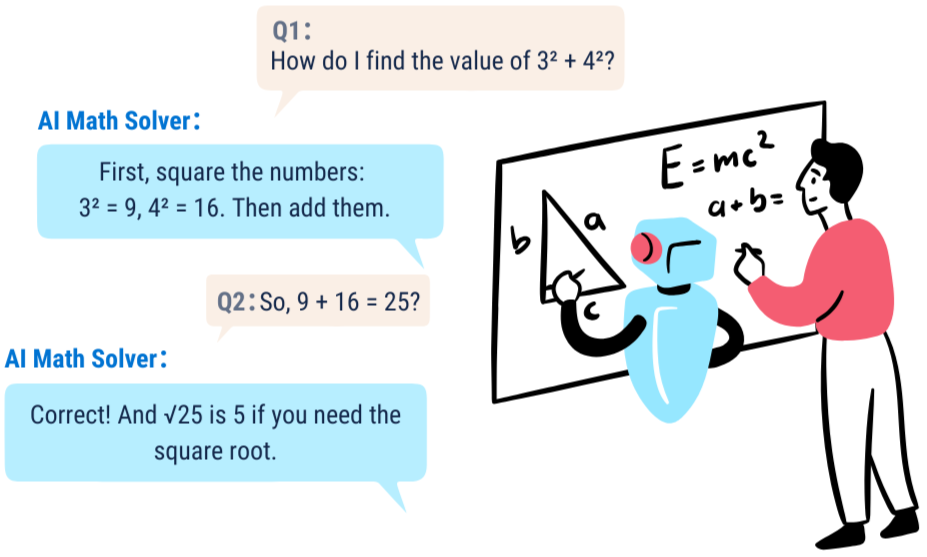
For better results, students can follow a few practical habits:
-
Read the complete question and identify the unknown variable before beginning.
-
Attempt the calculation independently before checking a digital solution.
-
Review each step instead of concentrating only on the final answer.
-
Recalculate the result to confirm that it satisfies the original equation.
-
Practise similar questions to strengthen understanding and accuracy.
These habits encourage independent learning and reduce excessive dependence on automated answers. Over time, students can become more comfortable solving equations without requiring constant assistance.
Common Mistakes Students Make While Solving Algebra Problems
Algebra can become confusing when students overlook basic mathematical rules. One common mistake involves changing signs incorrectly while moving terms from one side of an equation to another. Although moving a term across the equality sign is often taught as changing its sign, students should understand that this shortcut represents performing the same inverse operation on both sides. Without understanding this principle, they may struggle when equations become more complicated.
Another frequent problem is ignoring the order of operations. Students sometimes perform addition before multiplication or forget to simplify expressions inside brackets. Such mistakes can change the entire result even when the remaining calculations are correct. Incorrect handling of negative numbers, fractions, exponents, and like terms can also lead to inaccurate answers.
Some learners depend too heavily on calculators and automated mathematical tools. While these resources can explain difficult problems, they cannot replace the thinking required to develop mathematical skills. Students who copy solutions without examining the reasoning may find it difficult to answer slightly different questions during examinations. The better approach is to use digital resources for clarification and then repeat the calculation independently.
The Role of Technology in Modern Mathematics Education
Technology is becoming increasingly important in education because it provides flexible ways to access information and practise academic subjects. Digital classrooms, educational applications, online exercises, and AI-supported learning platforms allow students to explore concepts beyond traditional textbooks. In mathematics, these resources can make abstract ideas easier to understand by presenting calculations, visual examples, and interactive activities.
Modern learning platforms may also help students study according to their individual needs. Some learners understand algebra quickly through written explanations, while others benefit from visual demonstrations or repeated examples. Digital resources can offer different forms of assistance, allowing students to revisit challenging topics whenever necessary. This flexibility is especially valuable for learners who need additional practice outside regular classroom hours.
However, technology should remain a supporting part of education rather than becoming the only learning method. Teachers provide essential guidance, explain difficult concepts, and help students develop reasoning abilities. Textbooks offer structured academic content, while classroom discussions encourage learners to ask questions and understand different approaches. Combining these traditional methods with digital resources creates a more balanced learning experience.
Benefits of Practising Algebra Regularly
Regular practice is one of the most effective ways to improve mathematical ability. Algebra requires students to remember rules, recognise patterns, and apply operations accurately. These abilities develop gradually through repeated exposure to different types of problems. Solving a variety of questions also helps learners understand how the same mathematical principle can be used in different situations.
A Maths Solver can complement regular practice by helping students review unfamiliar problems and understand calculation methods. When used thoughtfully, it can make revision more organised and help learners identify areas where they need additional attention. Students can maintain a record of difficult questions, revisit the relevant concepts, and attempt similar exercises to check whether their understanding has improved.
Consistent practice offers several educational advantages, including stronger calculation skills, improved concentration, better accuracy, and increased confidence. It also helps students prepare for examinations by making mathematical procedures more familiar. Rather than studying every topic at the last minute, learners should divide their revision into smaller sessions and gradually increase the difficulty of their exercises.
Practical Ways to Build Confidence in Algebra
Building confidence in mathematics begins with understanding that difficult concepts can become manageable through patience and consistent effort. Students should avoid comparing their learning speed with others because every learner develops mathematical skills differently. Instead, they should focus on understanding one topic at a time and gradually progress towards more advanced questions.
Creating a regular study routine can also improve learning outcomes. Students may begin with basic expressions, move towards linear equations, and then practise quadratic equations and other advanced topics. Reviewing earlier lessons before starting new material helps maintain continuity and reduces the possibility of forgetting important rules.
Another useful technique is to explain a mathematical solution in simple words. When students can describe why they subtracted a particular number or divided both sides of an equation, it demonstrates that they understand the underlying concept. Teaching a concept to another person or explaining it aloud can reveal gaps in understanding that may not be obvious when simply reading a solution.
Learners should also treat mistakes as part of the learning process. An incorrect answer can provide valuable information about which mathematical rule needs further attention. By reviewing errors, correcting calculations, and practising similar questions, students gradually develop a more reliable approach to solving algebra problems.
Choosing the Right Approach for Different Algebra Problems
Not every algebra problem requires the same solving method. Some equations can be solved through simple inverse operations, while others require factorisation, substitution, expansion, or the quadratic formula. Selecting an appropriate method depends on the structure of the equation and the mathematical information provided in the question.
For example, a simple equation such as x – 7 = 11 can be solved by adding seven to both sides. An equation containing brackets, such as 2(x + 3) = 14, requires expanding or simplifying the expression before isolating the variable. Similarly, a quadratic expression may require factorisation or another suitable method. Recognising these differences helps students work more efficiently and avoid unnecessary calculations.
When using digital assistance, learners should check whether the suggested method matches the mathematical topic they are studying. If a classroom lesson focuses on factorisation, for instance, students should understand the factorisation method rather than automatically relying on another technique that produces the same result. Learning the required method is particularly important in examinations where the working process may carry marks.
Conclusion
Algebra is an essential mathematical subject that develops logical reasoning, analytical thinking, and problem-solving abilities. Although students may initially find variables, equations, and complex expressions challenging, these concepts become easier when they are studied through clear explanations and consistent practice. Understanding fundamental principles such as mathematical operations, linear equations, and quadratic expressions provides a strong foundation for more advanced learning.
A Maths Solver can support students by providing additional guidance, helping them examine calculation steps, and making difficult mathematical questions easier to approach. Its greatest educational value comes from encouraging learners to understand the reasoning behind each answer rather than simply collecting final results. Combining digital assistance with independent practice, classroom instruction, and regular revision creates a balanced approach to mathematics education.