
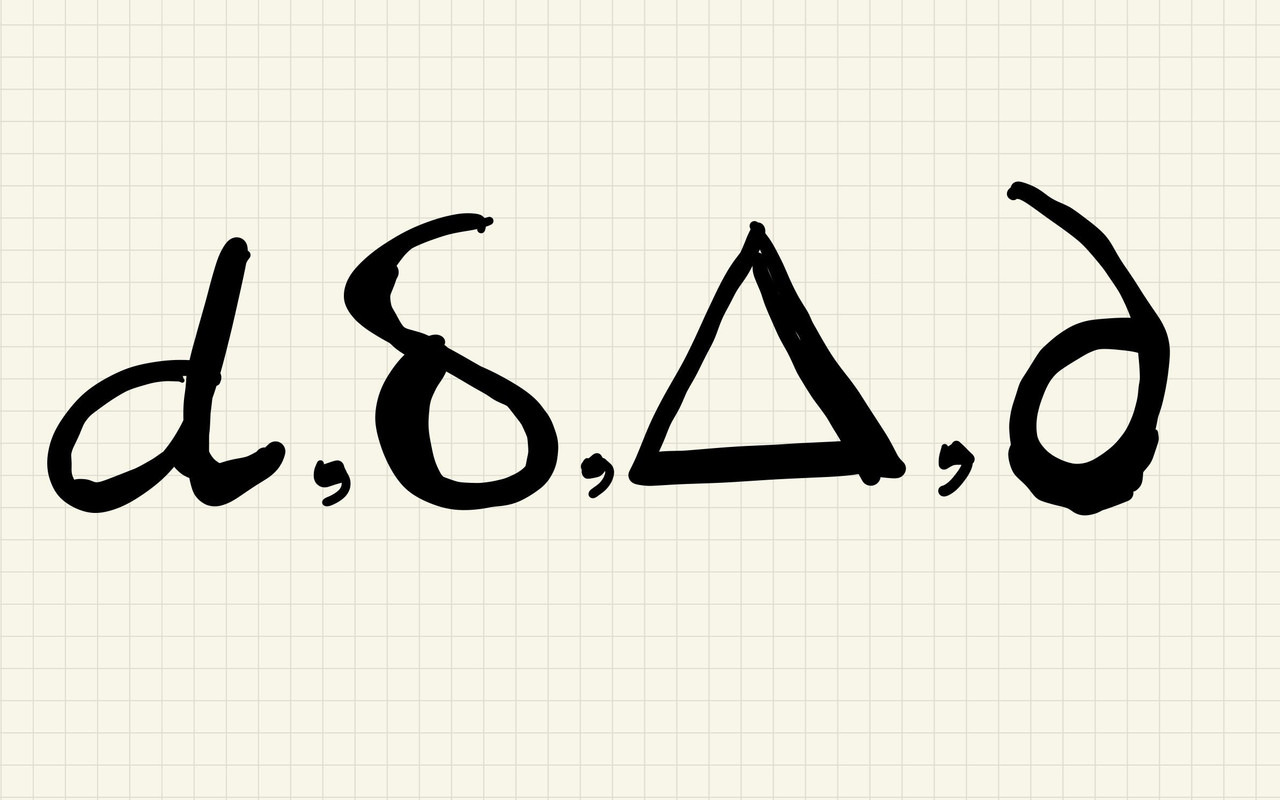
Mathematics often uses symbols to represent ideas that would otherwise require long explanations. One of the most useful symbols is the Greek letter delta, written as Δ. It commonly represents a change, difference, or variation between two values. The concept appears across algebra, geometry, calculus, statistics, physics, and many other technical subjects. Understanding deltaa math can therefore help students recognize mathematical relationships more quickly and solve problems with greater confidence.
At its simplest, delta can be understood as the difference between a final value and an initial value. If a quantity changes from 10 to 16, its change is 6. This can be written as Δx = 16 − 10 = 6. Although the calculation is simple, the concept becomes increasingly important when studying functions, rates of change, quadratic equations, and calculus. Learning what delta represents and how it is used provides a strong foundation for understanding more advanced mathematics.
What Does Delta Mean in Mathematics?
The word delta comes from the Greek alphabet, where uppercase delta is represented by Δ and lowercase delta by δ. In elementary and intermediate mathematics, uppercase Δ frequently describes a difference or change between two quantities. For example, Δx means “change in x,” while Δy means “change in y.”
The basic formula is:
Δx = Final Value − Initial Value
Suppose the temperature changes from 20°C to 27°C. The change can be calculated as:
ΔT = 27 − 20 = 7°C
This means the temperature increased by 7°C. If the final value were smaller than the starting value, the result would be negative. For example, a quantity changing from 30 to 22 produces a change of −8. The negative sign indicates a decrease rather than an increase.
This simple idea is central to deltaa math because many mathematical problems are concerned not only with values themselves but also with how those values change.
Why Is Delta Important in Mathematics?
Delta is important because mathematics frequently examines relationships between changing quantities. A single number can tell us the current state of something, but a difference can tell us how much that state has changed.
For instance, imagine a car traveling at different speeds. If its speed changes from 50 kilometers per hour to 80 kilometers per hour, the speed difference is 30 kilometers per hour. Similarly, if a business’s revenue increases from $5,000 to $7,500, the change is $2,500.
In algebra and calculus, changes become even more meaningful. The difference between two x-values can be compared with the difference between their corresponding y-values. This leads to concepts such as slope and rate of change. In calculus, the idea of change eventually develops into derivatives, which measure how quickly one quantity changes relative to another.
Because of this, students who understand delta early often find later mathematical topics easier to follow.
Delta and Change in Algebra
Algebra uses delta to describe differences between values. Consider a variable x that changes from x₁ to x₂. The change in x can be written as:
Δx = x₂ − x₁
The same approach applies to y:
Δy = y₂ − y₁
These expressions become especially useful when calculating the slope of a line. The slope formula is:
m = Δy / Δx
This is another important application of deltaa math. Instead of writing “the difference between the y-values divided by the difference between the x-values” every time, mathematicians use Δy/Δx as a concise representation.
For example, suppose two points are (2, 5) and (6, 13). The change in y is:
Δy = 13 − 5 = 8
The change in x is:
Δx = 6 − 2 = 4
Therefore:
m = 8/4 = 2
The line has a slope of 2.
Delta in Quadratic Equations
One of the most recognizable uses of the Greek letter delta occurs when solving quadratic equations. For an equation written as:
ax² + bx + c = 0
the discriminant is:
Δ = b² − 4ac
Here, delta does not simply represent an ordinary change. Instead, it is used as the name of a specific expression called the discriminant.

The value of the discriminant helps determine the nature of the solutions.
- If Δ > 0, the equation has two distinct real solutions.
- If Δ = 0, the equation has one repeated real solution.
- If Δ < 0, the equation has two complex solutions.
For example, consider:
x² − 5x + 6 = 0
Here, a = 1, b = −5, and c = 6.
Therefore:
Δ = (−5)² − 4(1)(6)
Δ = 25 − 24 = 1
Because the discriminant is positive, the quadratic equation has two distinct real solutions.
This application shows why understanding deltaa math requires recognizing that the same symbol can have different meanings depending on the mathematical context.
Delta and Calculus
Calculus focuses heavily on change. Before students study derivatives, they often encounter changes in variables through expressions such as Δx and Δy.
If x changes from one value to another, Δx represents that change. If the corresponding y-value also changes, Δy represents its change. The ratio:
Δy/Δx
describes the average rate of change over an interval.
For example, if a function’s output changes from 10 to 22 while its input changes from 2 to 5, then:
Δy = 22 − 10 = 12
and:
Δx = 5 − 2 = 3
So the average rate of change is:
Δy/Δx = 12/3 = 4
As the interval becomes smaller, the idea leads toward the derivative. In this way, delta provides an important bridge between basic algebra and calculus.
Delta in Geometry
Delta can also appear in geometry, although its meaning depends on the problem. In some situations, Δ is used to represent a change in a measurement. In other situations, a triangle symbol may be used to identify a triangle.
For example, a problem might describe a change in the length of a side, such as:
ΔL = New Length − Original Length
Geometry problems involving measurements, coordinates, transformations, and rates can therefore use delta notation to describe differences.
Students should always examine the surrounding information before deciding what Δ means. A symbol’s meaning is determined by the mathematical context rather than by the symbol alone.
Delta in Statistics and Data Analysis
Changes between data points are also important in statistics. Researchers may compare values from different years, groups, or experiments to determine whether something has increased or decreased.
For example, if the average score of a group rises from 68 to 75, the absolute change is:
ΔScore = 75 − 68 = 7
Delta can also be used when studying changes in variables, differences between measurements, and changes over time. In data analysis, understanding differences is often just as important as understanding individual values.
A company might compare monthly sales, a scientist might compare experimental measurements, or an analyst might examine changes in customer activity. In each situation, calculating the difference helps reveal the direction and size of change.
How to Calculate Delta Step by Step
Calculating delta is usually straightforward when it represents change. Follow these steps:
Step 1: Identify the initial value.
Determine where the measurement or variable begins.
Step 2: Identify the final value.
Find the value after the change has occurred.
Step 3: Subtract the initial value from the final value.
Use:
Δ = Final Value − Initial Value
Step 4: Interpret the result.
A positive answer generally indicates an increase, while a negative answer indicates a decrease.
For example, if a student’s score changes from 72 to 89:
ΔScore = 89 − 72 = 17
The score increased by 17 points.
If another student’s score changes from 91 to 84:
ΔScore = 84 − 91 = −7
The score decreased by 7 points.
This straightforward process makes deltaa math accessible even to beginners who are encountering mathematical notation for the first time.
Common Mistakes Students Make With Delta
One common mistake is reversing the order of subtraction. When delta represents change, the standard calculation is final value minus initial value. Reversing the order changes the sign of the answer.
Another mistake is assuming that Δ always has exactly the same meaning. In one problem, it may represent a change in a variable. In a quadratic equation, it may represent the discriminant. In another context, it may have a specialized definition.
Students should therefore read the complete problem rather than focusing only on the symbol.
A third mistake is ignoring negative values. A negative delta is not necessarily an error. It often indicates that the quantity has decreased. Understanding the meaning of the sign is an important part of interpreting mathematical results correctly.
Practical Examples of Delta
Consider a water tank containing 500 liters at the beginning of the day and 650 liters at the end. The change is:
ΔV = 650 − 500 = 150 liters
The tank gained 150 liters.
Now consider a savings account that contains $2,000 initially and $1,650 later:
ΔBalance = 1,650 − 2,000 = −350
The negative value indicates a reduction of $350.
Another example involves distance. If a runner travels from 3 kilometers to 11 kilometers during a training session:
ΔDistance = 11 − 3 = 8 kilometers
These examples demonstrate how the same fundamental concept can be applied to money, measurements, distance, temperature, scores, and many other quantities.
How Delta Supports Advanced Mathematics
The concept of change becomes increasingly powerful as mathematical study progresses. In algebra, it helps describe differences. In coordinate geometry, it contributes to slope calculations. In calculus, changes between variables become the foundation for understanding derivatives and rates.
Students studying science and engineering encounter similar concepts when analyzing motion, energy, temperature, electrical signals, and other changing quantities. Even when notation becomes more advanced, the underlying idea remains familiar: compare one state with another and determine how much it has changed.
For this reason, learning deltaa math is not simply about memorizing a Greek letter. It is about developing an intuitive understanding of mathematical change and relationships.
Tips for Learning Delta Concepts Easily
The best way to learn delta-related concepts is through repeated practical examples. Start with simple numbers and calculate changes in everyday quantities such as temperature, distance, money, or scores. Once the basic idea becomes familiar, move toward algebraic expressions and graphs.
It is also helpful to pay attention to signs. A positive result usually means an increase, while a negative result usually means a decrease. When studying quadratic equations, separately learn the discriminant formula and understand how its value affects the solutions.
Finally, avoid memorizing formulas without understanding their purpose. Ask what each value represents, what is changing, and why the calculation is being performed. This approach makes mathematical notation easier to remember and apply.
Conclusion
Delta is a small symbol with a wide range of applications throughout mathematics. Most commonly, it represents a change or difference between two values, but it can also identify specialized mathematical expressions such as the discriminant of a quadratic equation. From algebra and geometry to calculus and statistics, the concept helps students understand how quantities relate and change.
Learning deltaa math provides a useful foundation for more advanced mathematical thinking. By understanding final and initial values, interpreting positive and negative changes, and recognizing the context in which Δ is used, students can approach many mathematical problems with greater confidence. Rather than viewing delta as simply another symbol to memorize, it is better to see it as a concise way of describing change, comparison, and mathematical relationships.