

In mathematics, symbols often make complicated ideas easier to understand. One of the most useful symbols is the Greek letter delta, written as Δ. It commonly represents a change, difference, or amount of variation between two values. Students may encounter it in algebra, geometry, statistics, physics-related mathematics, and calculus, where understanding the meaning behind the symbol is often more important than simply memorizing a formula.
The meaning of delta depends on the mathematical situation in which it appears. In a simple problem, it can describe the difference between an original value and a new value. In another problem, Δ can appear in a geometric expression, such as the notation for a triangle. In quadratic equations, the discriminant is commonly written using the delta symbol. Therefore, learning dleta math concepts requires looking at how the symbol is being used rather than assuming that it always has one fixed meaning.
For students, the most common interpretation is that delta indicates a difference or change. For example, if a quantity increases from 15 to 22, the change is 7. This can be represented as Δx = 22 − 15 = 7. Once this basic idea is understood, many more advanced applications become easier to follow.
What Does Delta Mean in Math?
The Greek letter delta, Δ, is widely used to represent a difference between two quantities. When a variable changes from an initial value to a final value, delta can describe the amount of that change. The general idea can be expressed as Δx = final value − initial value. This convention allows mathematical expressions to communicate change without repeatedly writing long explanations.
For example, imagine that the temperature in a room rises from 18°C to 25°C. The temperature change is 25 − 18 = 7°C. In mathematical notation, this can be written as ΔT = 7°C. If the final value is smaller than the original value, the delta may be negative. A decrease from 25 to 18, for example, gives ΔT = 18 − 25 = −7°C. The negative sign communicates the direction of the change.
The same principle appears in many areas of mathematics. Dleta math is often searched by students who encounter the term in different lessons and want to understand whether it refers to change, difference, or another concept. The answer depends on the formula and subject being studied.
Why Is Delta Represented by Δ?
Delta comes from the Greek alphabet and is traditionally written as Δ when used as an uppercase mathematical symbol. Mathematicians use Greek letters extensively because they provide convenient symbols for quantities, angles, changes, constants, and other concepts. Over time, Δ became strongly associated with differences and changes in mathematical and scientific notation.
The symbol is particularly useful because it immediately distinguishes a change from the value itself. If x represents a quantity, then Δx can communicate “the change in x.” This is more concise than repeatedly writing “final x minus initial x.” The notation becomes especially valuable when several changing quantities appear in the same equation.
It is important to remember that Δ does not automatically mean one specific operation in every mathematical context. Its interpretation comes from the surrounding notation. A student should always examine the equation, chapter, or problem statement before deciding what delta represents.
Delta as Change Between Two Values
One of the simplest applications of delta is finding the difference between an old value and a new value. The general relationship is:
Δx = x₂ − x₁
Here, x₁ represents the starting value and x₂ represents the ending value. If x₂ is greater than x₁, the change is positive. If x₂ is smaller, the change is negative.
Suppose a company’s monthly production increases from 4,500 units to 5,200 units. The change is 5,200 − 4,500 = 700 units. Therefore, Δx is 700 units. If production instead falls from 5,200 units to 4,500 units, the change is −700 units. This distinction matters because a negative delta does not mean the calculation is wrong; it indicates a decrease.
In dleta math, this basic interpretation provides a useful foundation for more advanced concepts. Once students understand that delta can describe movement from one value to another, they can recognize similar notation in calculus, statistics, and applied mathematics.
Delta in Algebra
Delta has an important role in algebra, particularly when working with quadratic equations. A quadratic equation generally has the form ax² + bx + c = 0. When solving such equations, students often calculate the discriminant, which is represented by the Greek letter Δ.
The discriminant is calculated using:
Δ = b² − 4ac
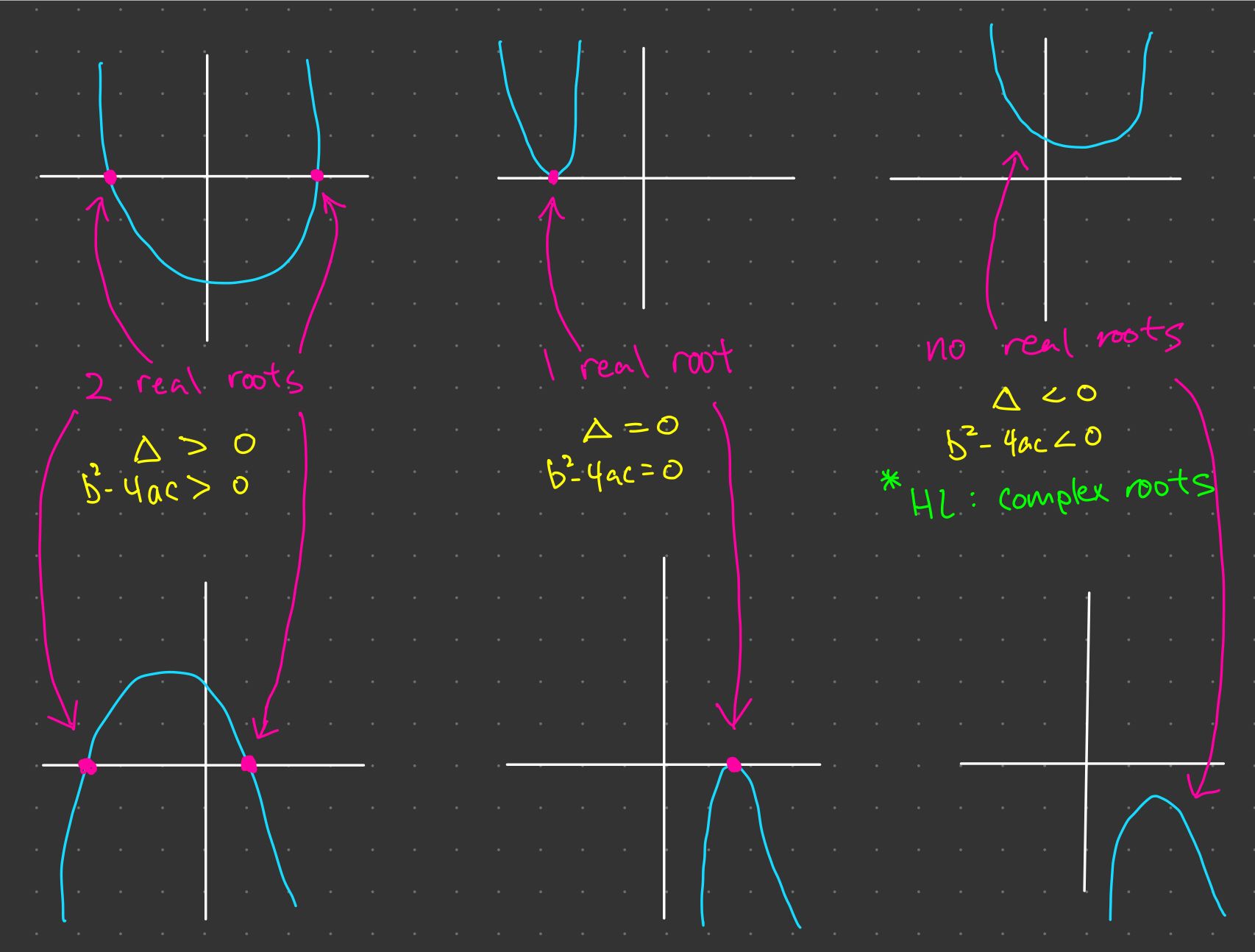
The value of the discriminant provides information about the nature of the solutions of the quadratic equation. When Δ is positive, the equation has two distinct real solutions. When Δ equals zero, the equation has one repeated real solution. When Δ is negative, the equation has no real solutions, although it has two complex solutions.
For example, consider x² − 5x + 6 = 0. Here, a = 1, b = −5, and c = 6. The discriminant is:
Δ = (−5)² − 4(1)(6)
Δ = 25 − 24 = 1
Because the discriminant is positive, the equation has two distinct real solutions. This is a different use of the delta symbol from simply describing change, demonstrating why mathematical context is essential.
Delta and Quadratic Equations
Understanding the discriminant can make quadratic equations easier to analyze before solving them completely. Instead of immediately applying the quadratic formula, a student can calculate Δ and determine what type of solutions should be expected.
The quadratic formula itself is:
x = (−b ± √Δ) / 2a
When the discriminant is positive, the square root of Δ is a real number, producing two different solutions. When Δ is zero, the plus-and-minus portion produces the same result twice. When Δ is negative, the square root involves an imaginary number.
| Discriminant | Nature of solutions | General interpretation |
|---|---|---|
| Δ > 0 | Two distinct real solutions | The graph generally crosses the x-axis twice |
| Δ = 0 | One repeated real solution | The graph touches the x-axis once |
| Δ < 0 | Two complex solutions | The graph has no real x-intercepts |
This application makes dleta math particularly important for algebra students because the same symbol that can describe change is also used for a specific algebraic quantity.
Delta in Geometry
Delta can appear in geometry in more than one way. The uppercase Greek letter Δ is commonly used to represent a triangle. For example, ΔABC means triangle ABC, where A, B, and C identify its three vertices.
This use is different from the “change” meaning discussed earlier. Here, Δ functions as a geometric symbol rather than a numerical operation. Students can determine the meaning from the notation surrounding it. If they see ΔABC, they should interpret it as triangle ABC rather than automatically calculating a difference.
Triangles are fundamental in geometry because they are used to study angles, side lengths, area, similarity, congruence, and many geometric relationships. Recognizing the delta symbol as triangle notation prevents confusion when moving between algebraic and geometric topics.
Delta in Calculus
The concept of change becomes even more important in calculus. Before students study derivatives, they often encounter expressions involving changes in variables. For example, Δx can represent a change in x, while Δy represents a corresponding change in y.
The average rate of change between two points can be written as:
Δy / Δx
This expression measures how much y changes compared with how much x changes. In coordinate geometry, it corresponds to the slope between two points. In calculus, the idea leads toward the derivative, where the change is examined over increasingly smaller intervals.
For example, if a function changes from y = 10 to y = 16 while x changes from 2 to 5, then Δy = 6 and Δx = 3. The average rate of change is therefore 6/3 = 2. This simple calculation provides an intuitive introduction to the idea of a derivative.
How Delta Helps Explain Real-World Change
Mathematics becomes more meaningful when symbols can describe real situations. Delta notation is useful because many real-world quantities constantly change. Businesses track changes in revenue, scientists measure changes in temperature, engineers analyze changes in measurements, and economists study changes in variables over time.
For example, if a company’s revenue changes from $80,000 to $92,000, the revenue change is $12,000. If a vehicle’s speed changes from 40 km/h to 65 km/h, its speed change is 25 km/h. The calculation itself is simple, but delta notation provides a compact way to communicate the result.
Percentage change is related but should not be confused with ordinary delta. A change from 80 to 92 has an absolute change of 12, while the percentage change is 12 ÷ 80 × 100 = 15%. Delta describes the numerical difference, whereas percentage change expresses that difference relative to the starting value.
Common Mistakes When Using Delta
Students sometimes assume that every appearance of Δ means “subtract two numbers.” That approach can lead to errors because delta has several established uses. In a change calculation, it commonly represents final minus initial. In a quadratic equation, it can represent the discriminant. In geometry, Δ may identify a triangle.

Another common mistake is ignoring the sign of the change. A negative value can be mathematically meaningful. If a quantity decreases, the negative sign tells the reader the direction of movement. Removing the sign simply because the answer “looks better” can change the meaning of the result.
Students can avoid many mistakes by asking what the symbol represents in the specific problem. Look at the equation, identify the variables, determine whether the topic is algebra, geometry, or calculus, and then apply the relevant definition.
Practical Ways to Understand Delta
Rather than memorizing isolated formulas, students can connect delta with the broader idea of comparison. Whenever two states of a quantity are being examined, ask what changed between the first state and the second. This approach makes notation easier to remember.
A useful learning process is:
- Identify the starting and ending values.
- Determine what quantity is changing.
- Calculate or interpret the relevant difference.
- Check whether the result should be positive, negative, zero, or another type of mathematical value.
Working through several different examples is more effective than memorizing the symbol alone. For instance, compare changes in temperature, distance, money, and algebraic variables. Then examine examples where Δ has a completely different role, such as triangle notation or the quadratic discriminant.
Delta Math in Modern Mathematical Learning
Today, students encounter mathematical notation through textbooks, online learning platforms, digital calculators, graphing applications, and educational software. These resources can make mathematical symbols easier to visualize, but the underlying definitions remain important. A calculator can produce a result, yet students still need to understand why a particular delta expression was used.
Digital graphing tools can be especially useful for understanding change. By observing two points on a graph, students can calculate Δx and Δy and then examine the relationship between them. This visual approach can connect basic arithmetic with more advanced ideas such as slope and derivatives.
The growing use of interactive mathematics tools also makes conceptual understanding increasingly valuable. Students who recognize what delta means can interpret equations more confidently rather than treating every formula as an isolated procedure.
Conclusion
The meaning of delta in mathematics depends on context, but one of its most important roles is representing change or difference between values. The notation Δ can help describe how a quantity moves from an initial state to a final state, making it useful in algebra, calculus, statistics, and applied mathematics. At the same time, delta has specialized meanings. In quadratic equations, the discriminant Δ = b² − 4ac helps determine the nature of solutions. In geometry, Δ can identify a triangle. These different applications show why understanding mathematical notation requires more than memorizing a single definition.