

Introduction
Mathematics in Class 9 introduces students to important concepts that form the foundation for higher-level studies. Topics such as number systems, polynomials, linear equations, geometry, coordinate geometry, and statistics require regular practice and a clear understanding of formulas. When students find a question difficult, a maths solver class 9 resource can help them understand the solution process and learn how to approach similar problems independently.
A maths solver may be a calculator, an educational website, a mobile application, or a step-by-step learning tool. These resources can explain mathematical operations, check answers, and help students identify mistakes. However, their real value comes from using them alongside textbooks, classroom lessons, and personal practice.
This guide explains how Class 9 maths solvers work, which topics they can help with, how to use them effectively, and how students can develop stronger problem-solving skills while preparing for school examinations.
What Is a Maths Solver Class 9?
A maths solver class 9 is a learning resource designed to assist students with mathematical questions from the ninth-grade syllabus. Depending on the tool, students can enter a question, select a topic, or upload a problem to receive an explanation or solution.
Some tools provide only the final answer, while others show intermediate calculations and reasoning. Step-by-step solvers are generally more useful for learning because they demonstrate how a problem is approached rather than simply displaying the result.
Students may use these resources to understand algebraic expressions, solve equations, simplify fractions, verify geometry calculations, or practise numerical problems.
A solver should be treated as a study assistant rather than a replacement for learning. Students who understand the method behind an answer are better prepared to solve unfamiliar questions during examinations.
Why Class 9 Students Need Maths Solvers
Class 9 mathematics includes several new concepts that may initially seem challenging. Students must learn to apply formulas, interpret questions, perform calculations accurately, and explain their reasoning.
A maths problem solver can make this process easier in several ways.
- Concept clarification: Students can review the steps involved in solving difficult questions.
- Error identification: Comparing personal calculations with a worked solution can reveal mistakes.
- Independent practice: Learners can attempt questions first and use the solver to check their answers.
- Time management: Quick verification helps students identify topics that require additional practice.
- Revision support: Previously difficult questions can be revisited before tests and examinations.
The most effective approach combines independent effort with guided assistance. Students should attempt each question before checking a solution, especially when preparing for school assessments.
Important Topics Covered by a Class 9 Maths Solver
A useful solver can support students across multiple areas of the Class 9 mathematics curriculum. The exact topics available depend on the tool and the syllabus it supports.
Number Systems: Students learn about rational and irrational numbers, real numbers, decimal expansions, and operations involving exponents. A solver can help simplify expressions and check calculations.
Polynomials: These questions involve coefficients, degrees, algebraic expressions, and polynomial identities. Solvers can demonstrate how to expand, simplify, or factor suitable expressions.
Linear Equations in Two Variables: Students learn to represent relationships using equations and understand their graphical solutions. A suitable tool can help verify whether an ordered pair satisfies an equation.
Coordinate Geometry: This topic introduces the Cartesian plane, axes, origin, and coordinates. Visual learning tools can help students understand the position of points.
Geometry: Lines, angles, triangles, quadrilaterals, and circles require logical reasoning. A solver can support calculations, although diagrams and theorem-based explanations remain essential.
Mensuration: Questions about surface areas, volumes, and related measurements require correct formulas and units. Calculators can help verify arithmetic.
Statistics and Probability: Students interpret data, calculate statistical measures, and explore basic probability concepts where included in their syllabus.
How to Use a Maths Solver Step by Step
Using a maths solver effectively requires more than entering a question and copying the answer. A structured method helps students turn each solution into a learning opportunity.
Step 1: Read the question carefully. Identify the information provided, the mathematical concept involved, and what the question asks you to find.
Step 2: Attempt the problem independently. Write down the formula, equation, or theorem that seems appropriate. Even an incomplete attempt can help you understand where you need assistance.
Step 3: Enter the question correctly. Use clear mathematical notation. Include brackets, exponents, fractions, and signs accurately to avoid receiving a solution to a different problem.
Step 4: Study the explanation. Check why each operation is performed and how the answer follows from the previous step.
Step 5: Compare your working. Identify the first point where your approach differs from the demonstrated solution.
Step 6: Solve a similar question. Close the solver and attempt another problem without assistance. This confirms whether you have understood the method.
Step 7: Record important mistakes. Maintain a notebook of difficult questions, formulas, and errors that you want to avoid in future tests.
Useful Examples for Class 9 Mathematics
Worked examples help students understand how mathematical rules apply to actual questions. Consider these basic problems.
Example 1: Simplifying an Algebraic Expression
Question: Simplify (3x+5x-2x).
Solution: Combine the like terms by adding their coefficients.
(3x+5x-2x=(3+5-2)x)
(=6x)
The answer is (6x). A solver can confirm the result, but students should understand that only terms containing the same variable with the same exponent can be combined directly.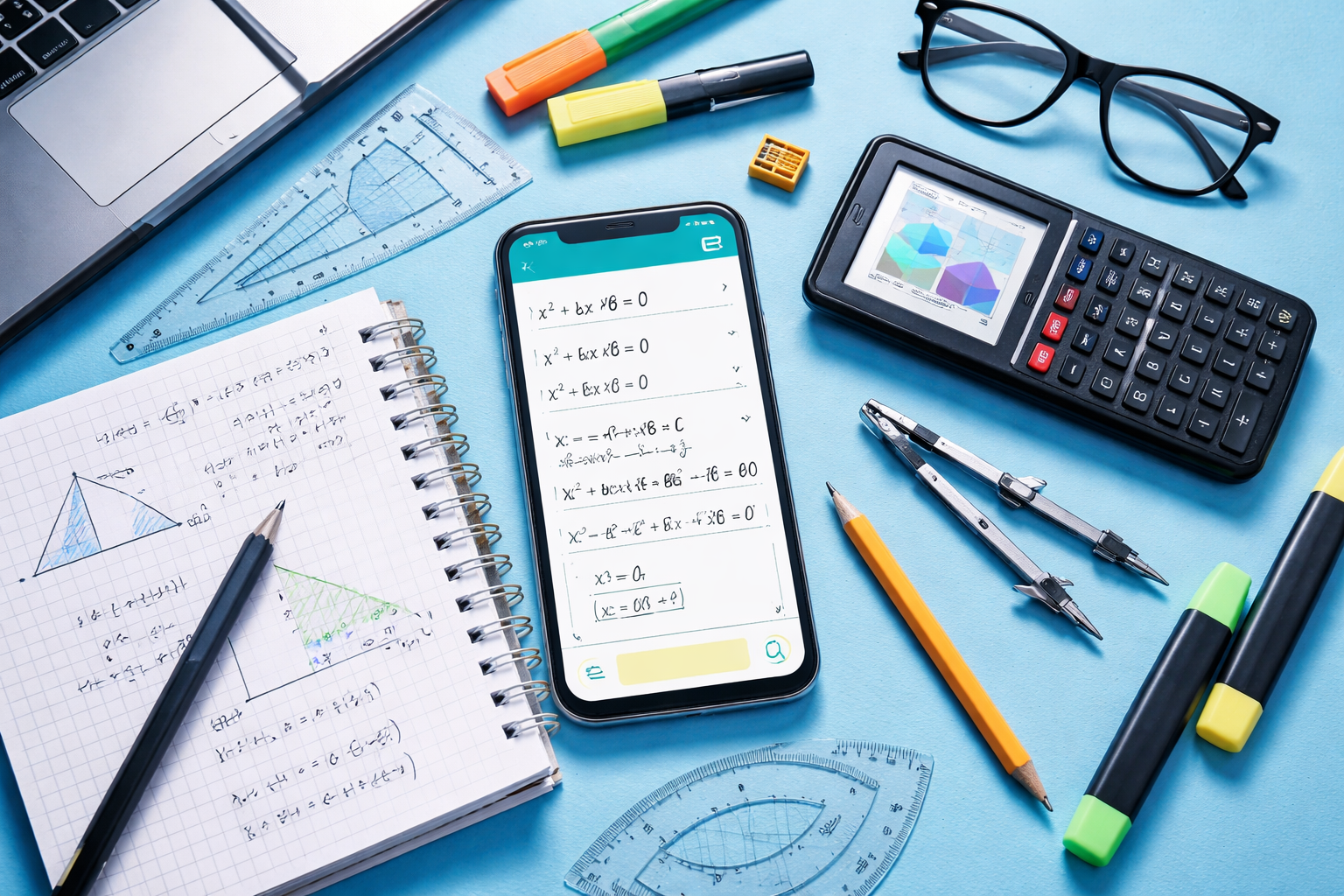
Example 2: Solving a Linear Equation
Question: Solve (2x+7=19).
Subtract seven from both sides.
(2x=19-7=12)
Divide both sides by two.
(x=6)
Checking the answer gives (2(6)+7=19), so the solution is correct.
Example 3: Finding the Area of a Triangle
Question: Find the area of a triangle with a base of 10 cm and a height of 6 cm.
Use the formula:
Area (=\frac{1}{2}\times\text{base}\times\text{height})
Area (=\frac{1}{2}\times10\times6=30\text{ cm}^2)
The area is 30 square centimetres. Notice that the answer uses square units because area measures a two-dimensional surface.
These examples demonstrate why understanding the steps is more valuable than memorising final answers.
Comparison of Different Maths Solving Methods
Students can choose between traditional working methods and digital assistance according to the problem and their learning needs.
| Solving Method | Main Benefit | Best Use |
|---|---|---|
| Textbook examples | Explain syllabus concepts | Learning fundamentals |
| Manual calculations | Develop independent skills | Examination preparation |
| Online maths solver | Provides quick assistance | Checking difficult questions |
| Scientific calculator | Supports numerical calculations | Verifying arithmetic |
| Video tutorials | Explain concepts visually | Understanding unfamiliar topics |
| Practice worksheets | Build speed and accuracy | Regular revision |
No single method is suitable for every situation. Textbooks establish the required concepts, manual calculations build confidence, and digital tools provide additional support when a student becomes stuck.
How to Choose the Best Maths Solver for Class 9
Choosing an appropriate tool can make studying more convenient. Before using a maths solver, consider whether it supports your syllabus and explains solutions clearly.
Look for step-by-step explanations. A tool that shows intermediate calculations can help you understand the method and reproduce it independently.
Check topic coverage. Confirm that the resource includes the chapters you are studying, such as algebra, geometry, number systems, and statistics.
Prefer clear mathematical notation. Fractions, powers, roots, and equations should appear correctly so that the explanation is easy to follow.
Consider ease of use. A simple interface makes entering questions and reviewing solutions less frustrating.
Check answer reliability. Compare important answers with textbook solutions or verify them through substitution and alternative calculations.
Protect your privacy. Avoid sharing unnecessary personal details when using educational websites or applications. Review permissions before installing a mobile app.
A useful tool should support learning without distracting students with unnecessary features or encouraging them to copy answers without understanding them.
Common Mistakes to Avoid When Using a Maths Solver
Although digital assistance can be helpful, incorrect habits may limit its educational value.
One common mistake is copying the final answer without reading the explanation. This may help complete a worksheet but does little to improve mathematical understanding.
Another mistake is relying on a solver for every question. Students need regular independent practice to develop calculation skills, logical reasoning, and confidence.
Entering a question incorrectly can also produce a misleading result. For example, missing brackets may change the order of operations. Always check that the expression entered matches the original question.
Students should also avoid assuming that every generated solution is correct. Some tools may misunderstand handwritten questions, interpret symbols incorrectly, or provide explanations that do not match the required school method.
Finally, do not neglect written presentation. During examinations, clearly showing formulas, substitutions, calculations, and final units can be important for demonstrating the method used.
Tips to Improve Class 9 Maths Performance
A maths solver works best when it is part of a consistent study routine. Students can improve their performance by following a few practical habits.
- Study one topic at a time instead of switching between unrelated chapters.
- Review formulas regularly and understand when each formula applies.
- Solve textbook examples before attempting more difficult questions.
- Practise a variety of problems rather than repeating only familiar ones.
- Write every important calculation clearly to reduce careless mistakes.
- Review incorrect answers and solve them again without looking at the solution.
- Ask teachers for clarification when a theorem or concept remains confusing.
- Complete timed practice sessions to improve speed and accuracy.
A balanced routine might include revising a concept, solving several questions independently, checking selected answers, and reviewing mistakes. Regular practice is generally more useful than trying to study every chapter in one long session.
Frequently Asked Questions About Maths Solver Class 9
What Is the Best Maths Solver for Class 9?
The best option is a reliable tool that supports your syllabus and provides understandable, step-by-step explanations. Choose a resource that helps you learn methods rather than simply displaying final answers.
Can a Maths Solver Help With NCERT Class 9 Questions?
Yes, many educational tools can assist with common NCERT-style topics, including number systems, polynomials, equations, geometry, and mensuration. Always check the explanation against your textbook and current syllabus.
Are Online Maths Solvers Free to Use?
Some online solvers offer free basic features, while others require payment for advanced explanations or additional services. Check the tool’s terms before using paid features.
Can a Maths Solver Explain Geometry Problems?
Some tools can assist with geometry calculations and selected theorem-based questions. However, complex proofs may require diagrams, logical reasoning, and explanations that are best developed through textbooks and teacher guidance.
Should Students Depend Completely on Maths Solvers?
No. Students should attempt questions independently and use solvers to clarify difficult steps or verify answers. Independent practice is essential for building mathematical understanding and examination confidence.
How Can I Prepare for Class 9 Maths Exams?
Revise concepts, practise textbook exercises, learn formulas, solve sample questions, and review mistakes regularly. Use a maths solver only when you need additional explanation or want to verify your working.
Conclusion
A maths solver class 9 can be a valuable learning resource for students who want to understand mathematical concepts, check calculations, and practise difficult questions more effectively. From number systems and polynomials to equations, geometry, and mensuration, the right tool can provide useful explanations and support independent learning.
However, successful mathematics study depends on more than obtaining correct answers. Students must understand formulas, practise calculations, explain their reasoning, and learn from mistakes. Combining textbooks, classroom instruction, regular exercises, and carefully selected digital tools creates a balanced approach to learning.