
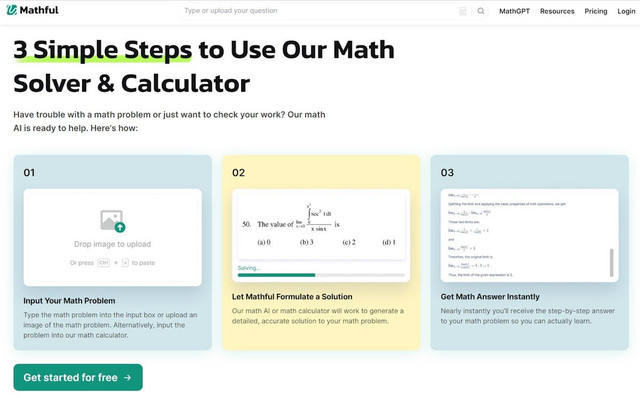
A maths solver with steps can make mathematical problem-solving easier by showing how an answer is reached instead of displaying only the final result. This approach is especially useful for students who want to understand calculations, identify mistakes, and build confidence with different types of problems. Whether the question involves basic arithmetic, algebra, geometry, percentages, equations, or more advanced calculations, seeing the working process can turn a confusing question into a sequence of manageable actions.
The value of step-by-step solving is not limited to getting correct answers. Mathematics depends heavily on logical order, formulas, relationships between quantities, and accurate calculations. When each stage is visible, learners can see which rule was applied and why the next operation was necessary. This makes mathematical practice more meaningful and can encourage independent problem-solving skills.
What Is a Maths Solver With Steps?
A maths solver with steps is a digital or educational solving method that breaks a mathematical question into individual stages. Instead of presenting an answer immediately, it explains the operations used to reach that answer. Depending on the type of problem, the solution may include formulas, substitutions, simplification, calculations, or a final verification.
For example, consider a simple equation such as 3x + 5 = 20. A step-by-step solution would first subtract 5 from both sides, producing 3x = 15. It would then divide both sides by 3 to find x = 5. The important part is not simply knowing that x equals 5. The working shows how the equation was transformed while maintaining equality on both sides.
This format can be particularly helpful when a learner understands the question but is uncertain about which operation should come first.
Why Step-by-Step Solutions Matter
A final answer can confirm whether a calculation is correct, but it does not always explain the reasoning behind it. Step-by-step mathematics addresses this gap by making the process visible.
Students can use detailed solutions to compare their own working with a completed example. If their answer differs, they can examine individual stages rather than starting the entire problem again. This makes error detection more practical.
Step-based explanations can also reinforce mathematical concepts. When solving an equation, for instance, a learner can repeatedly observe how inverse operations isolate an unknown value. With practice, this procedure becomes easier to recognize without assistance.
Another advantage is that step-by-step work encourages organized thinking. Instead of attempting several operations mentally, students learn to separate the problem into smaller tasks and record each transformation clearly.
Common Problems That Can Be Solved Step by Step
A useful maths solver with steps can support many categories of mathematics. The exact explanation depends on the problem, but common areas include:
- Arithmetic involving addition, subtraction, multiplication, and division
- Fractions, decimals, ratios, and percentages
- Linear and quadratic equations
- Algebraic expressions and simplification
- Geometry involving area, perimeter, and angles
- Exponents, roots, and scientific notation
- Word problems requiring multiple calculations
For instance, a percentage problem may require identifying the original quantity, converting the percentage into decimal form, and then multiplying the two values. Showing these stages helps learners understand the relationship between the percentage and the amount being calculated.
Geometry problems can benefit from the same approach. Rather than giving an area immediately, a solution can identify the appropriate formula, substitute the measurements, perform the calculation, and state the unit in the final answer.
How Step-by-Step Mathematical Solving Works
The solving process generally begins by interpreting the question. Before performing calculations, it is important to identify what information has been provided and what needs to be found.
The next stage is selecting an appropriate mathematical rule or formula. For an area question, this might mean choosing the formula for a rectangle, triangle, or circle. For an equation, it could involve using inverse operations to isolate the variable.
After selecting the method, values are substituted where necessary. Calculations are then performed in an appropriate order, following mathematical conventions such as the order of operations.
The final stage is checking the result. Verification may involve substituting an answer back into an equation, estimating whether a numerical result is reasonable, or checking whether the correct unit has been used.
| Problem Type | Typical Method | Useful Verification |
|---|---|---|
| Basic arithmetic | Apply operations in order | Recalculate or estimate |
| Linear equation | Isolate the variable | Substitute the answer |
| Percentage | Convert and calculate | Compare with an estimate |
| Geometry | Select and apply formula | Check units and dimensions |
| Quadratic equation | Factor, complete square, or use formula | Substitute roots |
| Fraction problem | Find common denominator or simplify | Recheck equivalent values |
Using a Solver as a Learning Tool
A maths solver with steps is most useful when it supports learning rather than replacing it. Students should first try to understand the question and make an attempt before checking a detailed solution. This creates an opportunity to compare their reasoning with another method.
When reviewing a solution, focus on the reason behind each operation. Ask why a particular formula was selected, why a value was moved to another side of an equation, or why a fraction was simplified in a certain way.
This habit can turn a digital solving tool into a form of guided practice. Instead of copying an answer, learners can identify the technique and apply it to a similar question independently.
Teachers and tutors can also use step-based examples to demonstrate procedures during lessons. A clearly structured solution can provide a reference point when explaining difficult concepts or correcting common calculation errors.
Benefits for Different Learning Levels
Beginners can benefit from seeing basic operations arranged in a logical sequence. This can reduce confusion when several calculations appear in the same question.
Intermediate learners may use step-by-step explanations to strengthen algebra, geometry, ratios, and equation-solving skills. At this level, understanding the transition between operations becomes increasingly important.
More advanced students can use detailed solutions for checking complex calculations or comparing different approaches. A solution may reveal an alternative method that is shorter, more systematic, or easier to verify.
The usefulness therefore depends less on the learner’s age and more on the complexity of the problem and the learner’s current understanding.
How to Read a Detailed Math Solution
A detailed solution should be read actively rather than passively. Start by identifying the original problem and the required result. Then examine each line and determine what changed from the previous line.
Pay attention to mathematical symbols and notation. A minus sign, exponent, bracket, fraction bar, or equality symbol can significantly affect the meaning of an expression.
It is also useful to distinguish between a mathematical rule and a simple calculation. For example, applying the distributive property is a mathematical transformation, while multiplying two numbers is a calculation. Recognizing this difference helps learners understand the structure of a solution.
If a step is unclear, recreate it independently on paper. Rewriting the operation can reveal whether the difficulty comes from the concept, arithmetic, or notation.
Avoiding Overreliance on Automated Answers
Although digital solving tools can be convenient, relying on them for every problem can limit opportunities for independent practice. Mathematics is a skill developed through repeated reasoning, not simply through exposure to correct answers.
A better approach is to attempt a problem first, use assistance when necessary, and then solve a comparable question without help. This process allows students to test whether they actually understood the method.
It is also important to check the original question carefully before accepting a generated solution. Incorrectly entered numbers, missing symbols, or misunderstood wording can produce an inappropriate result even when the calculation itself is performed correctly.
Making Step-by-Step Practice More Effective
The strongest results usually come from combining explanations with active practice. After reviewing a solution, learners can write down the main rule used and create a similar problem to solve independently.
Keeping calculations organized also makes mistakes easier to identify. Writing one meaningful operation per line is often clearer than combining several transformations into one expression.
Useful habits include:
- Estimate the expected answer before calculating when possible.
- Write down formulas before substituting values.
- Check signs, units, decimal points, and fractions carefully.
- Verify equation answers by substitution.
- Practice the same method with several variations.
These habits improve accuracy while gradually reducing dependence on external assistance.
Maths Solver With Steps for Everyday Problem Solving
Mathematics appears in many practical situations outside classrooms. People calculate discounts, compare prices, adjust recipes, estimate travel expenses, measure spaces, and interpret percentages in everyday life.
Step-by-step solving can make these tasks easier to understand because the process resembles the way practical calculations are performed manually. For example, calculating a discount involves identifying the original price, determining the discount amount, and subtracting that amount from the original value.
The same structured approach can be applied to budgeting, measurements, time calculations, and data interpretation. Understanding the process makes it easier to adapt a mathematical method when the numbers or circumstances change.
Conclusion
A maths solver with steps can be a valuable resource for understanding mathematical procedures, checking calculations, and improving problem-solving habits. Its greatest benefit comes from showing the reasoning behind an answer rather than treating the final number as the entire solution.
When learners examine formulas, operations, substitutions, and verification carefully, they gain a clearer picture of how mathematics works. Used alongside independent practice, written calculations, and regular review, step-by-step solving can support stronger understanding across arithmetic, algebra, geometry, percentages, and many other areas.