
Introduction
Mathematics often feels overwhelming at first, especially when unfamiliar terms are introduced. However, some concepts are surprisingly simple once broken down properly. One of those concepts is the “mean,” a fundamental idea that forms the backbone of statistics and everyday calculations. If you have ever asked yourself what is mean in math, you are not alone. It is one of the most commonly searched and widely used mathematical ideas.
In simple terms, the mean represents the average of a set of numbers. It helps reduce a group of values into a single number that reflects the overall trend. Whether you are calculating your exam scores, analyzing business profits, or understanding data in research, the mean plays a crucial role.
This article will walk you through everything you need to know about the mean—from its definition and formula to its real-life applications and limitations. By the end, you will have a clear and practical understanding of how to use it effectively.
What Is Mean in Mathematics?
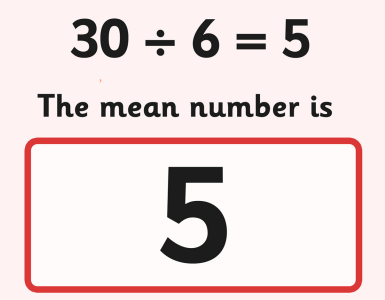
When people ask what is mean in math, they are usually referring to the arithmetic mean, which is the most common type of average. The mean is calculated by adding all the numbers in a data set and then dividing the total by how many numbers are present.
This concept is powerful because it provides a single value that represents a larger group. Instead of analyzing every number individually, the mean allows us to quickly understand the general behavior of the data.
For example, if a student scores 70, 80, and 90 in three tests, the mean score gives a better overall picture than looking at each score separately. It acts as a summary that simplifies decision-making and comparison.
Basic Formula of Mean
The formula for calculating the mean is straightforward and easy to remember:
Mean=Sum of all valuesNumber of values\text{Mean} = \frac{\text{Sum of all values}}{\text{Number of values}}Mean=Number of valuesSum of all values
This formula is used across different fields, from basic school math to advanced statistical analysis. Once you understand this, you have already grasped the foundation of what is mean in math.
Understanding Mean Through Simple Examples
To truly understand the concept, let’s explore a few examples.
Imagine you have the numbers 5, 10, and 15. First, you add them together, which gives you 30. Then, you divide this sum by the number of values, which is 3. The result is 10, which is the mean.
In another example, consider the numbers 2, 4, 6, and 8. Their sum is 20, and there are 4 numbers. Dividing 20 by 4 gives a mean of 5.
These examples demonstrate that the mean acts like a balance point. It represents where the values would settle if they were evenly distributed.
Why Mean Is Important in Daily Life
Understanding what is mean in math is not just useful for exams—it has real-world applications that affect everyday decisions. From budgeting to analyzing trends, the mean helps simplify complex information.
In education, students use the mean to calculate their average marks and evaluate performance over time. In finance, individuals and businesses use it to understand income, expenses, and profitability. Weather reports rely on mean temperature to summarize climate patterns.
Even in sports, the mean is used to measure player performance, such as average runs scored or goals made. Without the concept of mean, it would be much harder to compare results or identify trends.
Different Types of Mean
While most people associate the mean with a simple average, there are actually different types of mean used in mathematics and statistics. Each type serves a specific purpose depending on the situation.
Arithmetic Mean
The arithmetic mean is the most commonly used form. It is what people usually mean when they talk about averages. It works best when dealing with simple numerical data.
This type is widely used in schools, businesses, and everyday calculations because of its simplicity and effectiveness.
Geometric Mean
The geometric mean is used when dealing with multiplication or growth rates. Instead of adding numbers, you multiply them and then take the root based on the number of values.
This type is often used in finance, especially when calculating investment returns over time.
Harmonic Mean
The harmonic mean is used when dealing with rates, such as speed or ratios. It is particularly useful when time and distance are involved.
Although it is less commonly used than the arithmetic mean, it plays an important role in specific scenarios.
Comparison of Different Types of Mean
| Type of Mean | Method of Calculation | Best Used For |
|---|---|---|
| Arithmetic Mean | Add values and divide by count | General averages |
| Geometric Mean | Multiply values and take root | Growth rates and percentages |
| Harmonic Mean | Reciprocal-based calculation | Speed, ratios, and rates |
This comparison highlights that while all three are types of mean, they are not interchangeable. Choosing the right type depends on the nature of the data.
Mean vs Median vs Mode
When learning what is mean in math, it is important to understand how it differs from other measures of central tendency.
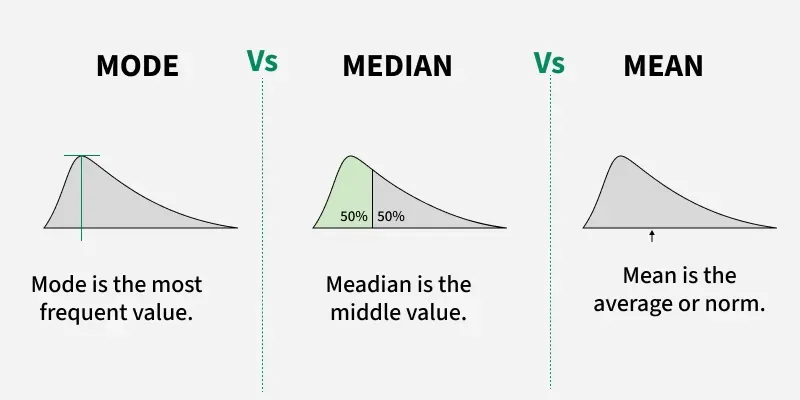
The mean is the average of all values. The median is the middle value when the data is arranged in order. The mode is the value that appears most frequently.
For example, in the data set 2, 3, 3, 5, 10, the mean is 4.6, the median is 3, and the mode is also 3. Each measure provides a different perspective on the data.
The Effect of Outliers on Mean
One important limitation of the mean is that it is sensitive to extreme values, also known as outliers. An outlier is a number that is significantly higher or lower than the rest.
For instance, consider the numbers 10, 12, 14, and 100. The mean becomes much higher due to the value 100, even though most numbers are close to each other.
This shows that while the mean is useful, it does not always represent the true nature of the data.
Real-Life Scenario with Outliers
Imagine a company where most employees earn between ₹20,000 and ₹30,000, but the CEO earns ₹5,00,000. The mean salary will appear very high, even though most employees earn much less.
This is why understanding what is mean in math also involves knowing when not to rely on it alone.
Advantages of Mean
The mean is widely used because of its simplicity and usefulness. It is easy to calculate and understand, making it accessible even to beginners.
It also considers all values in a data set, which makes it a comprehensive measure. This is why it is often the first choice for analyzing data.
Limitations of Mean
Despite its advantages, the mean has certain drawbacks. It can be heavily influenced by extreme values, which may lead to misleading conclusions.
It is also not suitable for all types of data, especially when the data is unevenly distributed. In such cases, other measures like median may be more appropriate.
Applications of Mean in Various Fields
The mean is used in many different fields, making it one of the most important concepts in mathematics.
In business, it helps analyze profits, losses, and trends. In healthcare, it is used to track patient data and medical statistics. In education, it helps evaluate student performance.
Understanding what is mean in math opens the door to interpreting data across various disciplines.
Mean in Data Analysis
In statistics, the mean is often the starting point for data analysis. It provides a quick summary of the data and helps identify patterns.
However, analysts usually combine it with other measures to get a more complete understanding. This ensures that decisions are based on accurate and reliable information.
How Mean Helps in Decision Making
The mean plays a crucial role in decision-making processes. Businesses use it to determine pricing strategies and forecast future performance.
Governments rely on it for economic planning and policy-making. Individuals use it for budgeting and financial planning.
By understanding what is mean in math, you can make more informed and confident decisions.
Visualizing the Concept of Mean
A helpful way to understand the mean is to think of it as a balance point. Imagine placing numbers on a number line. The mean is the point where the values balance evenly.
This visualization makes it easier to grasp the concept, especially for beginners.
Common Mistakes When Calculating Mean
Many beginners make simple mistakes when calculating the mean. One common error is forgetting to divide by the total number of values.
Another mistake is adding numbers incorrectly, which leads to wrong results. Some people also ignore decimal values, which can affect accuracy.
Being aware of these mistakes helps improve your calculations.
Tips for Accurate Mean Calculation
To calculate the mean accurately, always double-check your addition. Make sure you count the number of values correctly before dividing.
Using a calculator for large data sets can also help reduce errors. Regular practice is key to mastering the concept.
Practice Problems
Try solving these problems to test your understanding:
Find the mean of 6, 12, and 18.
Find the mean of 3, 9, 15, and 21.
Practicing such questions will strengthen your grasp of what is mean in math.
FAQs About Mean in Mathematics
What is the simplest way to define mean?
The mean is the average of a set of numbers calculated by adding them and dividing by the total count.
Why is mean useful?
It simplifies a group of numbers into a single value, making it easier to understand and compare data.
Can mean be used for all types of data?
No, it may not be suitable for data with extreme values or uneven distribution.
Is mean always the best measure?
Not always. Sometimes median or mode may provide a better representation of the data.
How is mean used in real life?
It is used in education, business, healthcare, and many other fields to analyze and interpret data.
Key Highlights
- Mean represents the average of a data set
- Calculated using sum divided by total values
- Widely used in real-life applications
- Sensitive to extreme values
- Works best with evenly distributed data
Conclusion: Why Understanding Mean Truly Matters
The concept of mean is one of the most essential building blocks in mathematics and statistics. It provides a simple yet powerful way to summarize and interpret data. From calculating exam scores to analyzing business trends, the mean is everywhere.
By now, you should have a strong understanding of what is mean in math, including how to calculate it, when to use it, and its limitations. The key to mastering this concept lies in consistent practice and real-life application.
Start applying the mean in your daily life—whether it’s tracking expenses, analyzing results, or making decisions. Over time, this simple concept will become a valuable tool that helps you understand the world through numbers.