
Introduction to the Delta Symbol
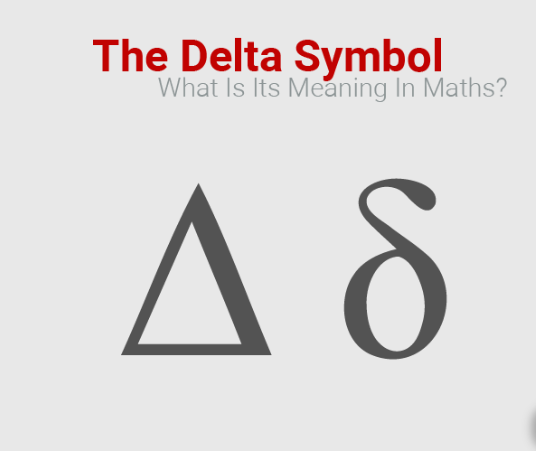
Mathematics often communicates big ideas through small symbols, and among them, the delta math symbol stands out as one of the most meaningful and versatile. Represented by the Greek letter Δ (uppercase) or δ (lowercase), delta is used across various disciplines to express the idea of change. Whether you are dealing with simple arithmetic, complex calculus, or scientific measurements, delta helps describe how one quantity differs from another.
At its core, delta answers a very simple but important question: “How much has something changed?” This idea might sound basic, but it forms the foundation of many advanced concepts in mathematics and science. From tracking temperature differences to calculating the slope of a line, delta appears everywhere.
In this article, we will explore the meaning, applications, and significance of delta in a detailed yet easy-to-understand way. By the end, you will not only recognize the symbol but also appreciate how powerful it truly is.
What Does the Delta Symbol Represent?
The delta math symbol primarily represents the difference between two values. It is commonly used when comparing an initial value with a final value. This difference can indicate growth, decline, or any form of variation.
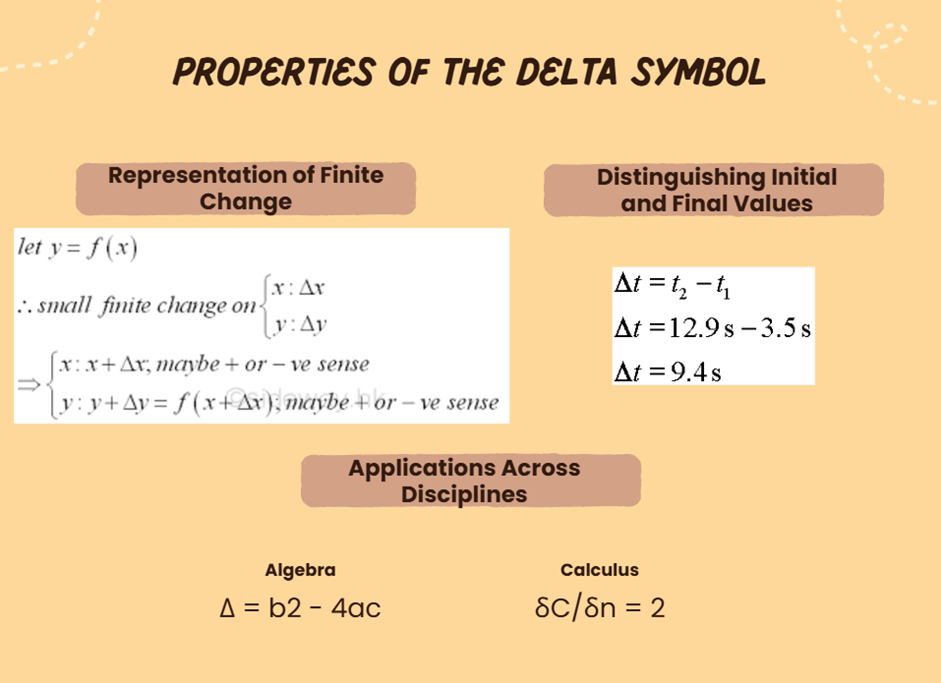
For example, if a variable changes from one state to another, delta captures that transition. It is usually written as:
Δx = x₂ − x₁
Here, x₁ is the initial value, and x₂ is the final value. The result, Δx, tells you how much the value has changed.
This simple idea becomes incredibly useful when analyzing patterns, trends, and relationships between variables. Instead of focusing on absolute values, delta helps you focus on movement and transformation.
Historical Background of Delta
The delta symbol comes from the Greek alphabet, where it is the fourth letter. Ancient Greek scholars and mathematicians contributed greatly to modern mathematics, and many of their symbols are still used today.
Over time, mathematicians adopted Δ to represent change because of its simplicity and clarity. The triangular shape of the uppercase delta even visually suggests a shift or transformation, which makes it fitting for its purpose.
As mathematics evolved, the delta math symbol became standard in fields like algebra, geometry, and calculus. Later, scientists and engineers also adopted it for measuring changes in physical quantities.
Understanding Change Through Delta
To truly understand delta, it helps to think in terms of real-life scenarios. Imagine you are tracking your daily steps using a fitness app. Yesterday you walked 5,000 steps, and today you walked 7,000 steps. The change in your steps can be expressed using delta:
Δsteps = 7,000 − 5,000 = 2,000
This number tells you exactly how much improvement occurred. Without delta, you would only have two separate numbers, but no clear sense of progression.
The same idea applies in many situations, such as tracking profits in a business, measuring temperature differences, or analyzing data trends. This is why the delta math symbol is so widely used—it simplifies comparisons and highlights meaningful changes.
Delta in Algebra
Tracking Variable Changes
In algebra, delta is frequently used to show how variables change within equations. Instead of simply solving for a value, you often want to understand how one variable responds when another changes.
For instance, if x increases over time, Δx helps you quantify that increase. This becomes especially useful in problems involving sequences, patterns, or relationships between variables.
Simplifying Problem Solving
Using delta can make complex algebraic problems easier to understand. By focusing on differences rather than absolute values, you can break problems into smaller, more manageable parts.
For example, when analyzing how one value affects another, you can isolate the change using delta instead of dealing with the entire equation at once.
Delta in Geometry
Changes in Coordinates
In geometry, delta is often used to describe changes in position. If you have two points on a graph, delta helps you measure the horizontal and vertical differences between them.
These differences are essential for calculating distances, slopes, and transformations. Without delta, it would be much harder to analyze how shapes move or change.
Understanding Slope
One of the most common uses of delta in geometry is calculating the slope of a line. The slope tells you how steep a line is, and it is defined as the ratio of vertical change to horizontal change.
m=ΔyΔxm = \frac{\Delta y}{\Delta x}m=ΔxΔy
This formula shows that slope depends entirely on the changes in coordinates. By using delta, you can easily determine whether a line is increasing, decreasing, or constant.
Delta in Calculus
The Foundation of Derivatives
Calculus takes the concept of change to a deeper level, and delta plays a crucial role in this process. When studying derivatives, you begin by examining how a function changes over small intervals.
The ratio Δy/Δx represents the average rate of change. As the interval becomes smaller, this ratio approaches the instantaneous rate of change, which is the derivative.
Limits and Precision
In calculus, delta is often used alongside limits to describe extremely small changes. This allows mathematicians to analyze continuous functions with high precision.
The transition from finite changes (Δ) to infinitesimal changes (d) is one of the key ideas in calculus. It shows how the delta math symbol serves as a bridge between basic algebra and advanced mathematical concepts.
Uppercase vs Lowercase Delta
The delta symbol appears in two forms, and each has a specific meaning.
Uppercase Δ is typically used for larger, measurable changes. It is common in algebra, geometry, and basic physics.
Lowercase δ, on the other hand, represents very small or precise changes. It is often used in advanced mathematics and scientific calculations.
Understanding the difference between these two forms is important because using the wrong one can lead to confusion or incorrect interpretations.
Applications of Delta in Science
Physics and Motion
In physics, delta is used to measure changes in physical quantities such as velocity, time, and energy. For example, Δv represents the change in velocity, which is essential for understanding acceleration.
Similarly, Δt represents the change in time, helping scientists analyze motion and speed. These calculations are fundamental to many areas of physics.
Chemistry and Energy Changes
In chemistry, delta is often used to describe changes in energy during reactions. For instance, ΔH represents the change in enthalpy, which indicates whether a reaction releases or absorbs heat.
This use of the delta math symbol helps chemists understand how reactions behave under different conditions.
Real-Life Applications of Delta
Delta is not limited to academic subjects; it plays a significant role in everyday life.
In finance, delta is used to track profit or loss over time. If a company’s revenue increases, the change is represented using delta.
In weather forecasting, meteorologists use delta to measure temperature and pressure changes. These differences help predict future weather conditions.
Even in personal life, delta can be used to track progress, such as weight loss, savings growth, or performance improvements.
Comparison Table: Delta in Different Fields
| Field | Use of Delta | Example |
|---|---|---|
| Mathematics | Change in variables | Δx = x₂ − x₁ |
| Geometry | Difference in coordinates | Δy / Δx |
| Physics | Change in motion quantities | Δv, Δt |
| Chemistry | Energy change in reactions | ΔH |
| Finance | Profit or loss difference | ΔP |
This table highlights how the concept of change is consistent across different disciplines, even though the context may vary.
Common Mistakes When Using Delta
Many learners misunderstand delta, especially when first encountering it.
One common mistake is reversing the order of subtraction. Since Δx = x₂ − x₁, switching the values can lead to incorrect results.
Another mistake is confusing delta with other symbols, such as “d” in calculus. While they may look similar, they represent different concepts.
It is also important to remember that delta can be negative. A negative delta simply means that the value has decreased.
Why the Delta Symbol Matters
The importance of the delta math symbol lies in its ability to simplify complex ideas. Instead of dealing with entire datasets or equations, you can focus on changes, which are often more meaningful.
Delta helps identify trends, measure progress, and analyze relationships. Without it, many mathematical and scientific concepts would be harder to understand.
By mastering delta, you gain a powerful tool for interpreting data and solving problems in a wide range of fields.
Advanced Perspectives on Delta
As you move into higher-level mathematics, delta becomes even more significant.
In advanced calculus, delta is used in proofs and definitions involving limits. It helps establish the rigorous foundation of mathematical analysis.
In statistics, delta can represent changes in data distributions, helping analysts understand variability and trends.
In engineering, delta is used to measure system responses and optimize performance.
These advanced applications show that the delta math symbol is not just a basic concept but a cornerstone of modern science and technology.
Frequently Asked Questions (FAQs)
What is the delta symbol used for in math?
It is used to represent the change or difference between two values.
Is delta always positive?
No, delta can be positive or negative depending on whether the value increases or decreases.
What is the difference between Δ and δ?
Δ represents larger changes, while δ is used for very small or precise changes.
Why is delta important in calculus?
It helps define rates of change, which are essential for derivatives and limits.
Where is delta used in real life?
It is used in finance, science, engineering, and everyday measurements to track changes.
Key Takeaways
- Delta represents change or difference between values
- It is used in math, science, and real-life applications
- Δ indicates larger changes, while δ indicates smaller ones
- It plays a crucial role in algebra, geometry, and calculus
- Understanding delta improves problem-solving and analytical skills
Conclusion: Mastering the Concept of Change
The delta math symbol may appear simple, but its significance is profound. It serves as a universal language for describing change, connecting mathematics with real-world applications. From basic algebra to advanced calculus, delta provides a clear and efficient way to measure differences and understand relationships.
To truly master this concept, start applying it in everyday situations. Observe changes around you, whether in numbers, trends, or patterns, and think of them in terms of delta. This habit will not only strengthen your mathematical skills but also enhance your ability to analyze and interpret information.
In a world that is constantly changing, understanding delta gives you the tools to keep up, adapt, and make informed decisions.