
Introduction
Mathematics often feels complex, but some concepts are surprisingly simple once you understand their purpose. One such idea is the mean. Many students and learners frequently ask, what is the mean in math, especially when they encounter averages in schoolwork or real-life situations.
The concept of mean is not just limited to textbooks. It appears in everyday life—whether you’re calculating your exam scores, tracking your expenses, or even understanding weather patterns. It helps us summarize a group of numbers into one meaningful value that represents the whole set.
In this detailed guide, we will explore the meaning, formula, types, examples, uses, and deeper insights into this important mathematical concept. By the end, you will not only understand it clearly but also feel confident applying it in different situations.
What Is the Mean?

To truly understand what is the mean in math, imagine you have several numbers and want to find a single number that represents them all fairly. The mean does exactly that—it distributes the total equally among all values.
In simple words, the mean is the average of a group of numbers. It tells you what each number would be if all values were equal.
A Simple Way to Think About It
If five friends share 50 candies equally, each friend gets 10 candies. That “10” is the mean of the distribution.
So, instead of looking at all numbers individually, the mean gives you a single value that summarizes them.
The Formula of Mean
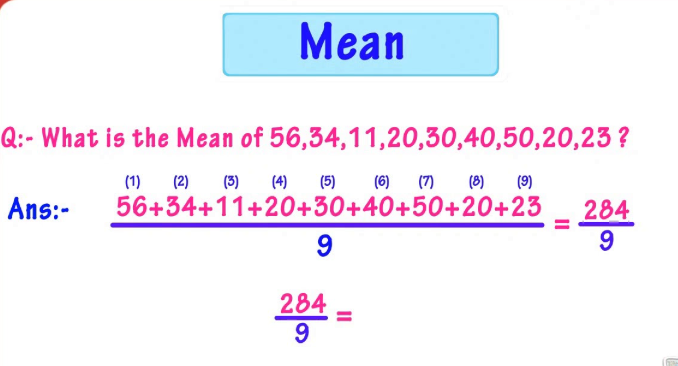
The formula for calculating the mean is straightforward and easy to remember:
Mean=Sum of all valuesTotal number of values\text{Mean} = \frac{\text{Sum of all values}}{\text{Total number of values}}Mean=Total number of valuesSum of all values
This formula works for most situations, especially when dealing with simple numerical data.
Breaking It Down
- First, add all the numbers together
- Then count how many numbers there are
- Finally, divide the total sum by the count
This process gives you the mean value.
Step-by-Step Example
Let’s take a simple example to make it clearer.
Example: Finding the Mean of Numbers
Numbers: 5, 10, 15, 20
Step 1: Add them → 5 + 10 + 15 + 20 = 50
Step 2: Count them → 4 numbers
Step 3: Divide → 50 ÷ 4 = 12.5
So, the mean is 12.5.
This example shows how easily you can calculate the average using the formula.
Why the Mean Matters
Understanding what is the mean in math is important because it helps simplify large amounts of data into a single understandable value.
Instead of analyzing multiple numbers separately, the mean provides a quick overview. It is widely used in education, business, science, and daily decision-making.
Practical Importance
- It helps compare different datasets
- It gives a general idea of performance
- It simplifies complex information
For example, a teacher can quickly understand a student’s overall performance by calculating the mean of their marks.
Types of Mean
While most people refer to the arithmetic mean, there are other types as well. Each type serves a different purpose depending on the situation.
Arithmetic Mean
This is the most common type. It is calculated by adding all numbers and dividing by the total count. It is used in everyday calculations and basic statistics.
Geometric Mean
The geometric mean is used when dealing with growth rates or percentages. Instead of adding numbers, you multiply them and then take the root.
It is often used in finance, especially when calculating investment growth over time.
Harmonic Mean
The harmonic mean is used when dealing with rates, such as speed or ratios. It gives more importance to smaller values and is useful in specific situations like averaging speeds.
Comparison of Different Means
| Type of Mean | Calculation Method | Best Use Case |
|---|---|---|
| Arithmetic Mean | Sum ÷ Count | General averages |
| Geometric Mean | Root of product | Growth rates, percentages |
| Harmonic Mean | Reciprocal formula | Rates like speed or density |
This comparison helps you understand when to use each type effectively.
Mean vs Median vs Mode
Many learners confuse these three terms. While they all describe data, they are different.
Mean
The average of all values. It considers every number in the dataset.
Median
The middle value when numbers are arranged in order.
Mode
The number that appears most frequently.
Understanding these differences is essential for proper data analysis.
Real-Life Applications of Mean
The concept of mean is not just theoretical—it plays a big role in real life.
In Education
Teachers calculate average marks to evaluate student performance. It helps in grading and identifying strengths or weaknesses.
In Finance
People use averages to understand income, expenses, and savings. Businesses rely on mean values for financial planning.
In Sports
Athletes’ performances are often measured using averages, such as batting averages or scoring averages.
In Weather Analysis
Meteorologists use averages to determine temperature trends and climate patterns.
Common Mistakes While Calculating Mean
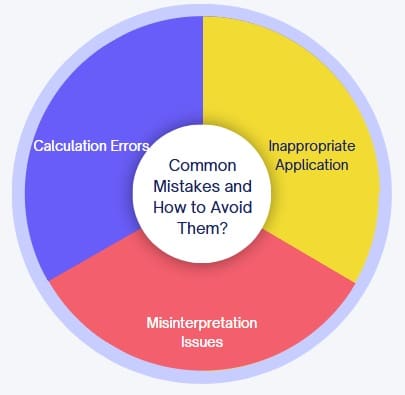
Even though the concept is simple, errors can occur.
Incorrect Addition
Adding numbers incorrectly leads to wrong results.
Wrong Count
Forgetting to count all numbers properly can change the mean.
Ignoring Outliers
Extreme values can distort the mean and make it misleading.
Being careful during calculations helps avoid these mistakes.
Advantages of Mean
The mean is widely used because of its simplicity and usefulness.
It is easy to calculate and understand, making it accessible to everyone. It also uses all values in a dataset, giving a complete picture.
Another advantage is its versatility—it can be applied in many fields, from academics to business.
Limitations of Mean
Despite its usefulness, the mean has some drawbacks.
It is sensitive to extreme values, also known as outliers. A single very high or low number can significantly affect the result.
In some cases, the mean may not represent the dataset accurately, especially when data is unevenly distributed.
Understanding Weighted Mean
Sometimes, not all values are equally important. In such cases, we use a weighted mean.
For example, in exams, different subjects may have different marks. The weighted mean takes this into account and gives a more accurate result.
Mean of Grouped Data
When dealing with large datasets, numbers are often grouped into intervals.
In such cases, calculating the mean requires a slightly different approach using frequency tables. This method is commonly used in statistics.
Visualizing the Mean
A helpful way to understand the mean is to think of it as a balance point.
Imagine placing numbers on a scale. The mean is the point where the scale balances perfectly. This visual idea makes the concept easier to grasp.
Practical Example with Table
Let’s look at a real-life example.
| Student | Marks |
|---|---|
| A | 65 |
| B | 70 |
| C | 75 |
| D | 80 |
| E | 90 |
Calculation
Total = 65 + 70 + 75 + 80 + 90 = 380
Number of students = 5
Mean = 380 ÷ 5 = 76
This shows the average performance of the class.
How Mean Helps in Decision Making
Understanding averages helps people make better decisions.
For example, a business owner can analyze average sales to plan future strategies. Similarly, individuals can use averages to manage budgets effectively.
Why Students Often Struggle
Many students find it difficult to understand what is the mean in math because they confuse it with other concepts or make calculation errors.
Another reason is lack of practice. Without solving enough problems, it becomes harder to grasp the concept fully.
Tips to Master the Mean
To become confident with this concept, regular practice is essential.
Start with simple numbers and gradually move to complex datasets. Always double-check your calculations to avoid mistakes.
Using real-life examples can also make learning more engaging and meaningful.
Quick Recap
Mean in Math Explained:
- It is the average of a set of numbers
- Formula: Sum ÷ Total count
- Used in academics, finance, and daily life
- Types include arithmetic, geometric, and harmonic
Deep Understanding of the Concept
To fully understand what is the mean in math, it’s important to see it as more than just a formula. It represents fairness and balance in numbers.
When values are evenly distributed, the mean reflects that equality. However, when values vary widely, the mean may not always tell the full story.
This deeper understanding helps in applying the concept correctly in different situations.
Applications in Modern World
In today’s data-driven world, averages are everywhere.
From analyzing social media trends to understanding economic growth, the mean plays a crucial role. Data scientists and analysts rely heavily on averages to interpret large datasets.
Even in everyday life, people use averages without realizing it—whether it’s calculating fuel efficiency or tracking daily expenses.
FAQs
1. What is the mean in math in simple terms?
It is the average of a set of numbers found by adding them and dividing by how many numbers there are.
2. Is mean always the best measure of average?
Not always. If there are extreme values, the mean may not represent the data accurately.
3. Can the mean be a decimal number?
Yes, the mean can be a whole number or a decimal depending on the dataset.
4. Why is the mean important in statistics?
It helps summarize large amounts of data into a single value, making analysis easier.
5. How is mean used in daily life?
It is used in budgeting, calculating marks, analyzing trends, and making decisions.
Conclusion
Understanding what is the mean in math is a fundamental step toward mastering mathematics and data analysis. It is a simple yet powerful concept that helps make sense of numbers in both academic and real-life situations.
By learning how to calculate and interpret the mean, you gain a valuable tool for problem-solving and decision-making. Whether you’re a student calculating marks or a professional analyzing data, this concept plays an essential role.
Practice regularly, apply it in real-life scenarios, and soon you will find that working with averages becomes second nature.
Read More:-Complete Guide to Accessing and Using DeltaMath Accounts